
In a bold step to combat persistent air pollution, Delhi is gearing up to witness its first-ever cloud seeding experiment in July 2025. The capital, often enveloped in toxic smog, is now looking skyward—literally—for a solution. If successful, the operation could serve as a milestone in urban climate intervention and open new paths for weather modification in India.
The project is being implemented through a collaborative effort between the Delhi Government, IIT Kanpur, and the Central Government, with key input from the India Meteorological Department (IMD) and approval from the Directorate General of Civil Aviation (DGCA).
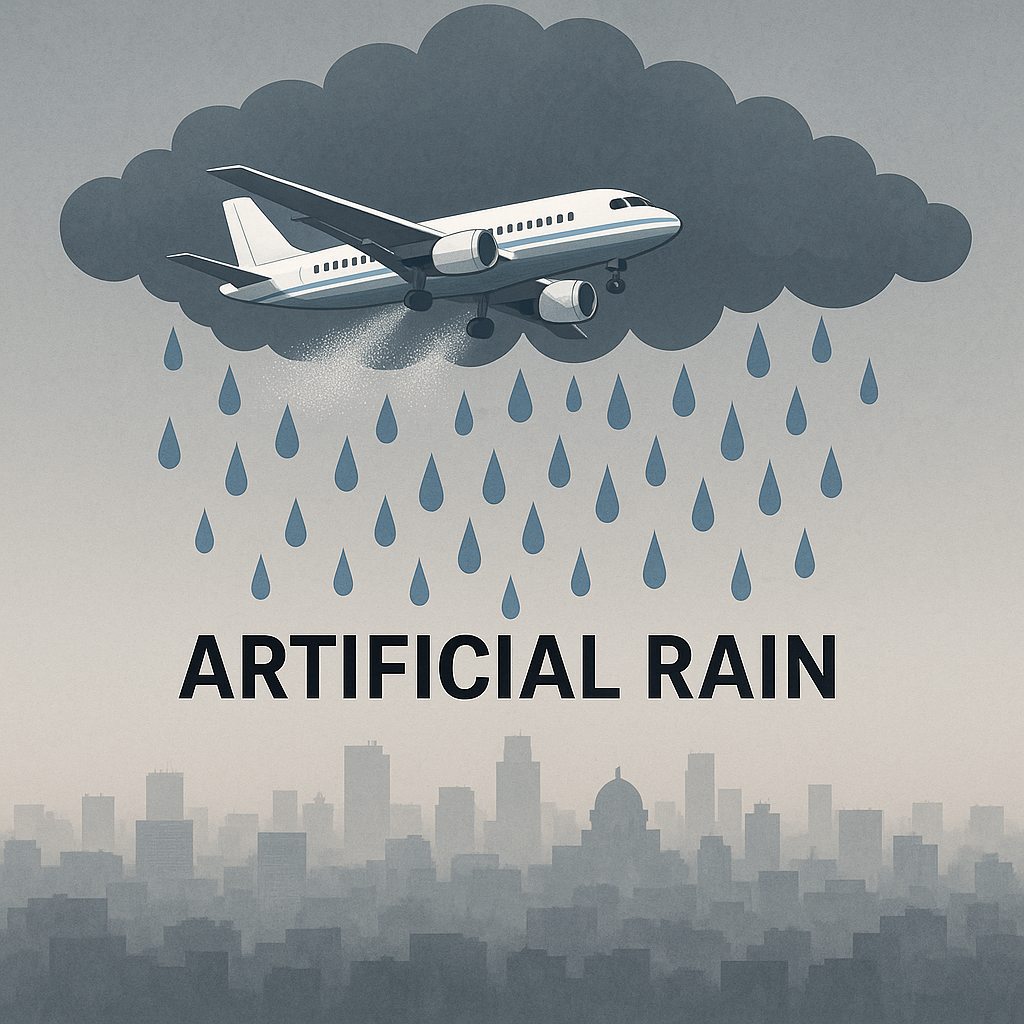
Cloud seeding is a technique that enhances a cloud’s ability to produce rainfall. It involves dispersing substances—most commonly silver iodide, sodium chloride, or potassium iodide—into the atmosphere. These particles serve as condensation nuclei, encouraging water droplets in the clouds to merge and eventually fall as rain.
In Delhi’s case, the process will be conducted via aircraft, which will release these particles into moisture-bearing clouds in specific regions of the city.
“The technique doesn’t create clouds—it enhances the rain potential of clouds that already exist,” explained an official associated with the IIT Kanpur-led project.
Delhi has long struggled with alarmingly high levels of air pollution, especially during the post-monsoon and winter months when stubble burning, vehicular emissions, and weather patterns trap pollutants near the ground.
The idea behind artificial rain is simple: rainfall helps wash away airborne particulate matter (PM2.5 and PM10), thereby reducing pollution and improving air quality. Natural monsoon rains already help during the season, but timing and volume are unpredictable.
With the city having limited control over emission sources in the short term, weather modification is being explored as a quick-response mechanism to bring relief.
The operation is currently scheduled for July 2025, which coincides with the monsoon window—when moisture-laden clouds are present and conducive for seeding.
According to meteorological experts, July offers the highest success probability due to naturally occurring cloud cover and ambient moisture.
The cloud seeding operation is not an isolated political move. It is backed by years of scientific research and trial modeling:
“We’ve studied multiple international models. The meteorological and chemical conditions in July are ideal for a small-scale test,” said a senior IIT Kanpur researcher.
Delhi is not the first city to attempt artificial rain. Other global examples include:
These examples show that while results vary, cloud seeding has a measurable impact when executed under the right conditions.
One of the common concerns around cloud seeding involves the chemicals used, particularly silver iodide. However, most scientific bodies, including the World Meteorological Organization, maintain that these chemicals are used in trace amounts and pose no significant environmental or health risk when applied as per safety standards.
Delhi’s planned operation adheres to international safety protocols, and environmental impact will be continuously monitored.
This pilot initiative is being seen as more than a one-time event. If successful, cloud seeding could:
It’s not a permanent fix, but as Delhi’s environment continues to strain under pressure, artificial rain may become part of a larger solution mix—one that combines policy, public awareness, and science-backed innovation.
Cloud seeding is a scientific process used to induce artificial rainfall by dispersing chemicals like silver iodide into moisture-laden clouds to accelerate precipitation.
Delhi is exploring cloud seeding to tackle rising air pollution by using rain to clear harmful particulate matter from the atmosphere during the monsoon.
The first trial is scheduled for July 2025, coinciding with Delhi’s monsoon season when cloud density is favorable for rain induction.
The Delhi Government is executing the project in collaboration with IIT Kanpur, the India Meteorological Department (IMD), and the Directorate General of Civil Aviation (DGCA).
Yes, the chemicals used in cloud seeding are applied in trace amounts and are considered safe by international scientific standards. The operation will be monitored for environmental impact.
Yes, rainfall from cloud seeding can temporarily reduce air pollution by washing away suspended particles like PM2.5 and PM10 from the air.
Countries like China, the UAE, and the U.S. have used cloud seeding for pollution control, drought mitigation, and weather management with varying success.
Part of the NCR Guide editorial team, covering news, real estate, food and lifestyle across Delhi NCR.
Join thousands of Delhi NCR residents who start their day with our morning brief — top stories, real estate updates, events and deals.