
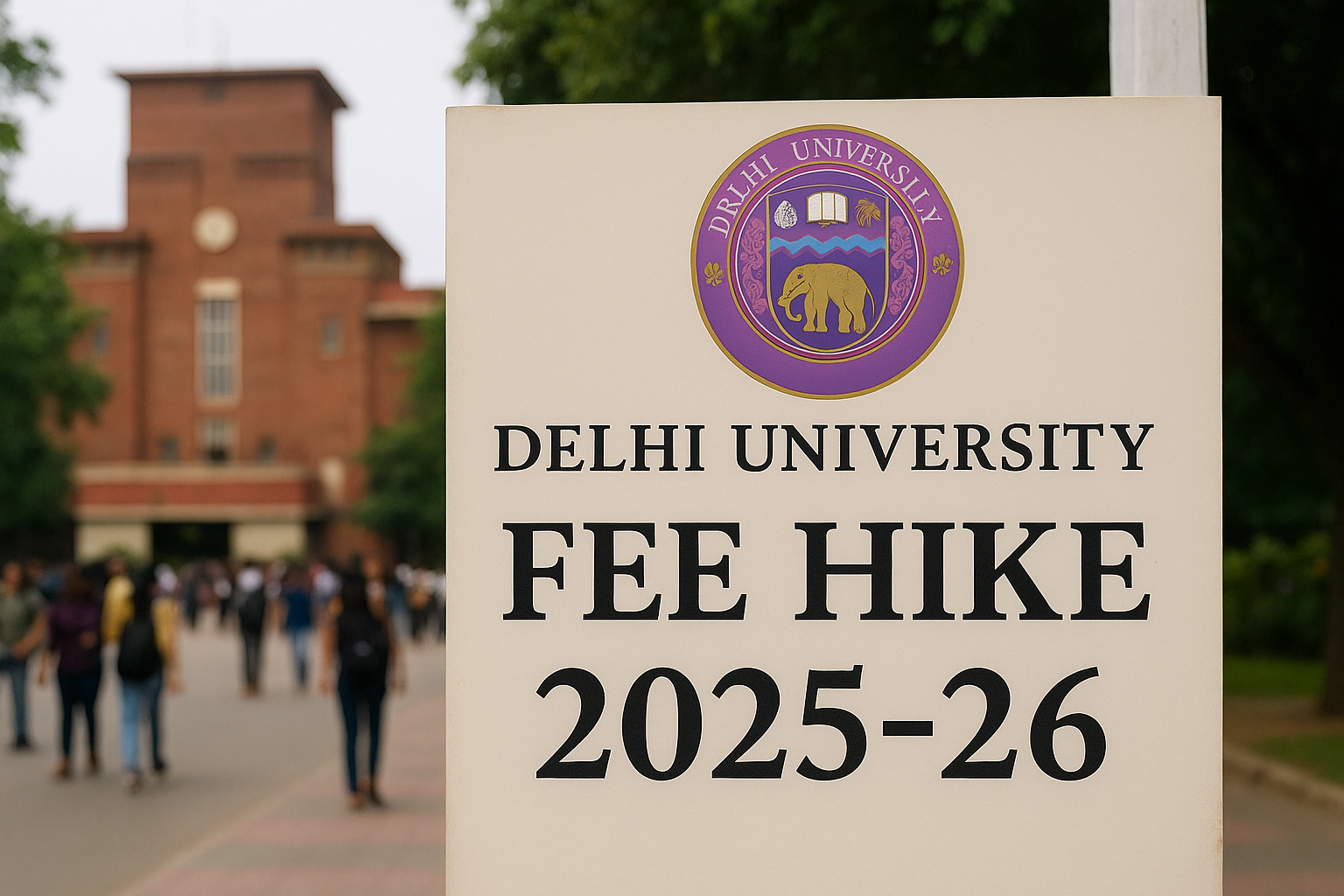

Delhi University (DU), one of India’s most prestigious public universities, has approved a sharp fee hike for the 2025–26 academic session, raising several charges by over 20–25% — a move that has sparked concern among students, faculty, and education advocates.
Despite DU’s internal policy that caps annual fee hikes at 10%, multiple components have been raised well beyond that limit.
These hikes follow similar increases in previous years. Since 2022, the Development Fund has gone up by 67%, Facilities Charges by 200%, and the EWS Welfare Fund by 150%, signaling a clear upward trajectory in cost to students.
Here’s how the updated fee structure looks across programs:
For distance learners, the School of Open Learning (SOL) has also seen fee hikes. The BA course, for instance, has jumped from ₹3,500 in 2020 to ₹10,230 in 2025, nearly tripling in five years.
The fee hike was passed on April 3, 2025, under the emergency powers of Vice Chancellor Yogesh Singh. While DU officials claim it is a “modest adjustment for inflation”, internal estimates suggest the university aims to collect over ₹246 crore from student fees in 2025–26 — up from ₹237 crore last year.
Even as DU receives significant public funding, including ₹1,000 crore via HEFA loans and ₹900 crore under its Institute of Eminence (IoE) status, its increasing reliance on student contributions is raising eyebrows.
DU officials argue the hike is necessary to maintain standards amid rising operational costs. A senior administrative official said:
“Inflation-adjusted revisions are routine. Students still pay far less at DU than at most private institutions. These hikes help sustain quality.”
Vice Chancellor Yogesh Singh has also stated that the hike is within “reasonable” bounds and partially offset by government funding.
Not everyone agrees. Critics from the teaching community and student unions have accused the university of quietly shifting the financial burden onto students — particularly those from marginalized and low-income backgrounds.
Prof. Pankaj Garg, INTEC member and former Academic Council representative, said:
“This fee hike is being justified in the name of infrastructure, but where is the transparency? Many colleges have seen no upgrades. Students are paying more but getting less.”
Abha Dev Habib, another prominent DU faculty voice, added:
“Making students fund the institution’s operations undermines the very purpose of a public university. This trend risks turning education into a commodity.”
If you’re a current or prospective DU student, here’s what you should be aware of:
The Delhi University fee hike isn’t just about numbers. It reflects a broader shift in how public institutions are being funded — away from state support and toward self-financing models, HEFA loans, and private contributions.
This change could have long-term consequences:
As one SOL student put it:
“They say DU is still affordable, but not for us. My family is struggling to pay this year’s fees — and the hostel is another battle.”
Why did Delhi University raise its fees this year?
DU officials claim the hike adjusts for inflation and rising operational costs. However, critics say it’s part of a shift toward self-financing education.
Which fees were increased the most?
The University Development Fund, Facilities & Services Charges, and EWS Welfare Fund were each increased by 20–25%, far exceeding DU’s usual 10% hike policy.
Will existing students be affected, or just the incoming batch?
All students, including those continuing in existing programs, will be subject to the new structure for 2025–26.
Are fee waivers or scholarships available?
Yes. DU offers multiple schemes under EWS, SC/ST, PwD, and other categories. Students should check with their department or college administration.
How do I check my college’s exact fee structure?
Each college may have slightly different fee details. Visit your specific college website or consult the DU admissions portal for course-wise fee breakdowns.
Can students challenge this fee hike?
While there’s no official petition yet, legal and administrative challenges are possible, especially if transparency or procedural issues are raised.
Part of the NCR Guide editorial team, covering news, real estate, food and lifestyle across Delhi NCR.
Join thousands of Delhi NCR residents who start their day with our morning brief — top stories, real estate updates, events and deals.