
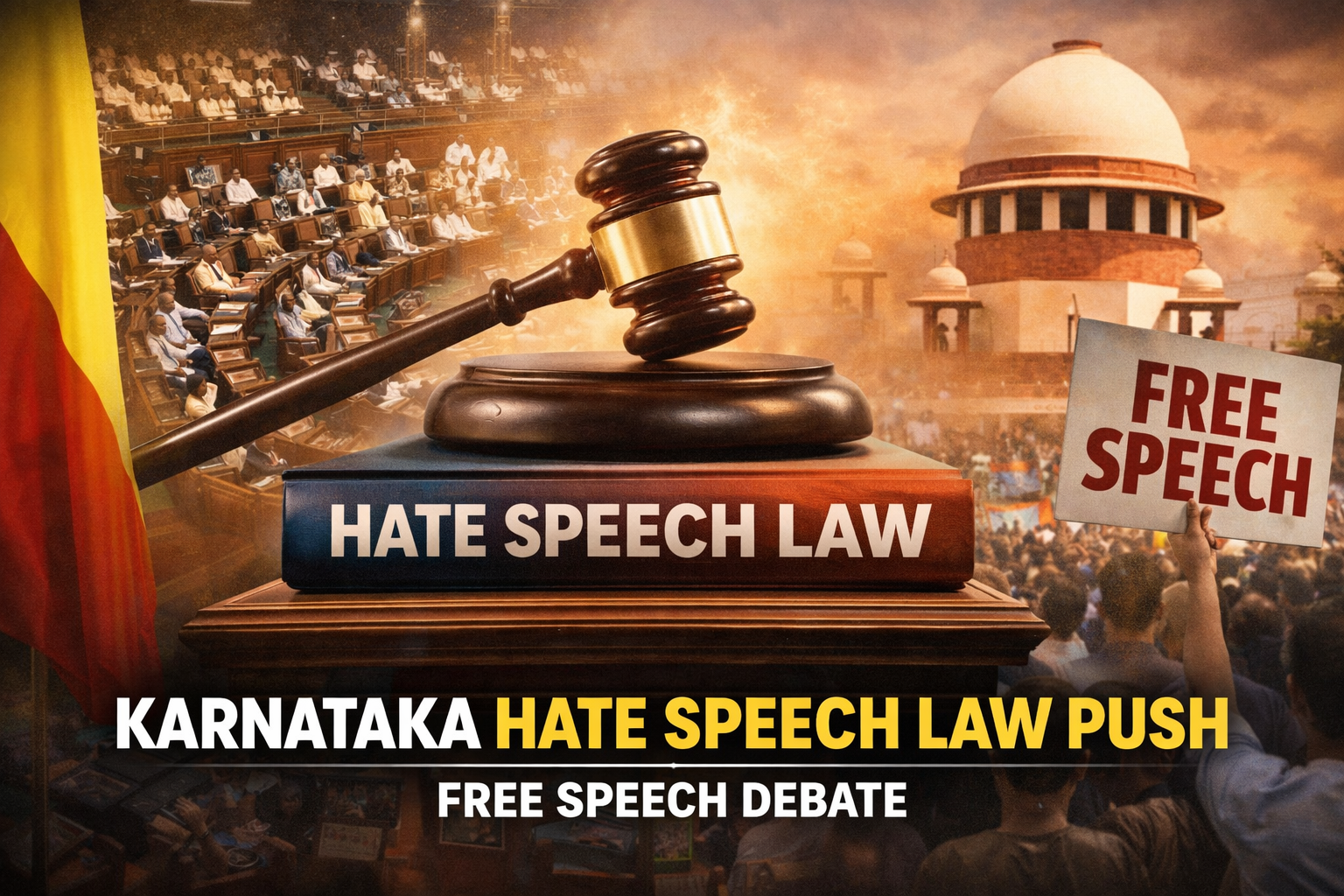

Karnataka has become the latest Indian state to attempt a tougher legal response to hate speech, proposing a dedicated law that supporters say will curb inflammatory public discourse but critics warn could deepen concerns around free expression and selective enforcement.
The move comes at a time when political rhetoric, religious polarisation, and viral online content have intensified scrutiny of how India regulates speech that crosses into hostility or incitement.
The Karnataka government says the proposed legislation is designed to clearly define hate speech and introduce penalties for speech that promotes enmity, discrimination, or violence against groups based on religion, caste, language, or identity.
State officials argue that while India already has provisions dealing with such offences, enforcement has been fragmented and slow. The new law, they say, would provide clarity for police and prosecutors and enable faster action in cases involving public rallies, election speeches, and digital platforms.
India’s criminal code already contains several provisions addressing hate speech, most notably Sections 153A and 295A of the Indian Penal Code. However, legal scholars point out that these laws are often applied inconsistently and are vulnerable to political influence.
According to constitutional experts, the problem is not the absence of law but uneven enforcement. High-profile cases frequently stall, while lower-profile speakers face swift action, creating a perception of bias that undermines public trust.
Any new hate speech law must align with constitutional safeguards laid down by the Supreme Court of India, which has consistently held that freedom of speech is a fundamental right, though subject to reasonable restrictions.
A landmark judgment frequently cited in this debate is Shreya Singhal v Union of India, in which the court struck down vague online speech restrictions for being overly broad and open to misuse. Legal analysts say Karnataka’s law will face similar scrutiny if definitions are not precise and narrowly tailored.
The court has also emphasised that restrictions on speech must demonstrate a clear and proximate link to public disorder, not merely offence or discomfort.
Civil liberties groups have expressed concern that a state-level hate speech law could be weaponised in politically charged environments, particularly during elections. In India’s polarised climate, allegations of hate speech are often entangled with party politics, raising fears of selective enforcement.
Former judges and senior advocates quoted in national media have warned that without strong procedural safeguards, such laws may disproportionately affect journalists, activists, and opposition leaders, while powerful figures remain untouched.
Hate speech today spreads rapidly across television networks and social media platforms that operate beyond state boundaries. This raises questions about the effectiveness of a state-specific law in regulating speech that is national or even global in reach.
Experts argue that coordination with central laws, digital intermediaries, and regulatory bodies is essential. Without this alignment, enforcement risks becoming symbolic rather than transformative.
Legal analysts say the success of Karnataka’s proposal will depend less on intent and more on execution. Clear definitions, transparent enforcement guidelines, independent oversight, and judicial review will be critical in determining whether the law curbs genuine harm or chills legitimate speech.
Training police officers, insulating investigations from political pressure, and ensuring timely court scrutiny are widely seen as prerequisites for meaningful impact.
Beyond Karnataka, the proposed law is being closely watched across India as a possible model or cautionary tale for other states. It reflects a broader struggle to balance social harmony with constitutional freedoms in an era of heightened political expression.
Whether the law becomes an effective deterrent or another contested statute will ultimately be decided not in legislative text alone, but in courtrooms, police stations, and the public sphere.
The proposal has been introduced by the Karnataka state government as part of efforts to address rising concerns around inflammatory public speech.
Yes. India has several provisions under the Indian Penal Code and election laws that address hate speech, but enforcement has often been inconsistent.
Potentially. While the Constitution allows reasonable restrictions, vague definitions or selective enforcement could impact legitimate expression.
Courts, especially the Supreme Court of India, will play a key role in interpreting the law and preventing misuse through judicial oversight.
Only partially. Online platforms operate nationally and internationally, requiring coordination with central laws and digital regulations.
Implementation timelines depend on legislative approval, final drafting, and the creation of enforcement guidelines.
Part of the NCR Guide editorial team, covering news, real estate, food and lifestyle across Delhi NCR.
Join thousands of Delhi NCR residents who start their day with our morning brief — top stories, real estate updates, events and deals.