
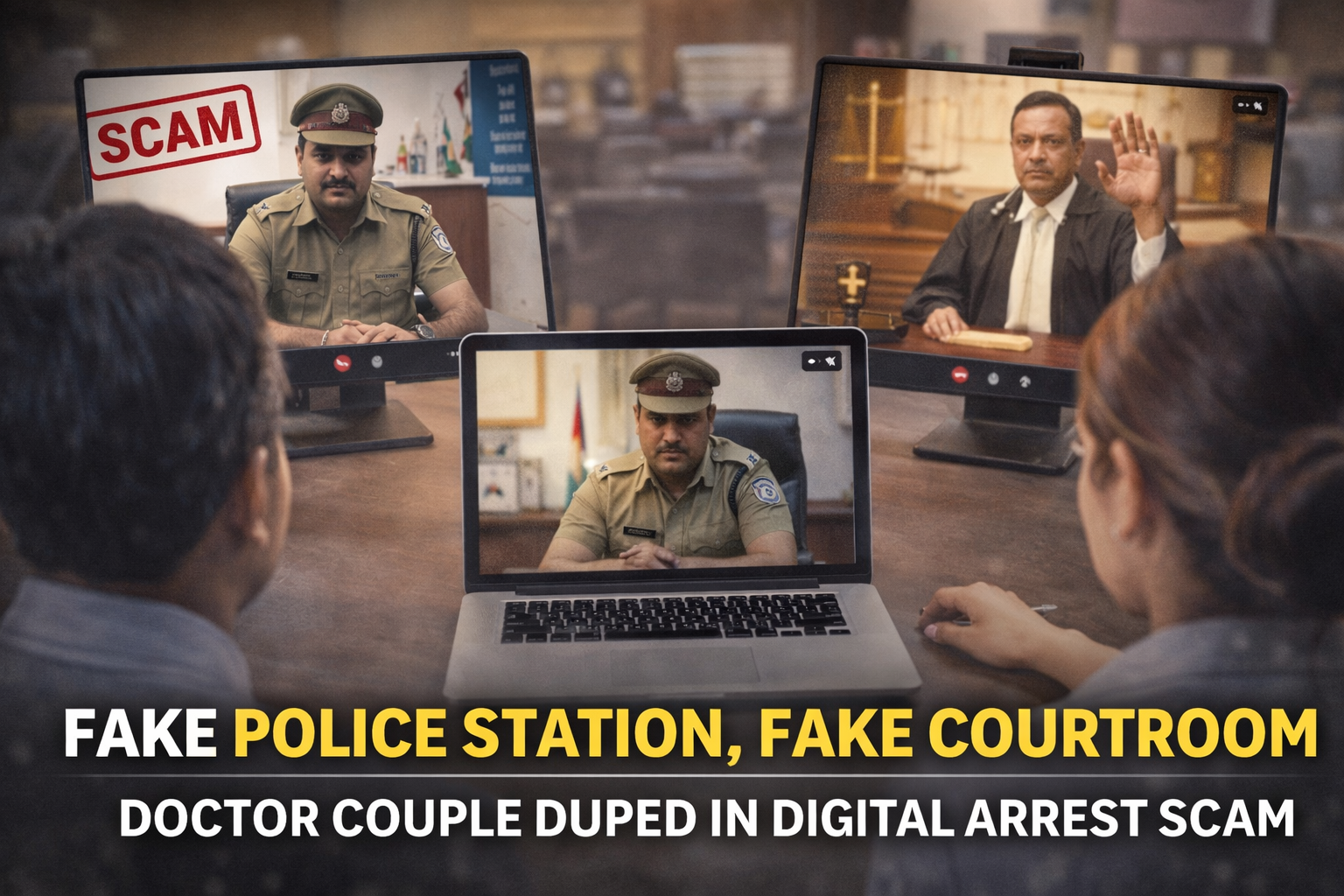

A Delhi-based doctor couple fell victim to an elaborate cybercrime after fraudsters staged a convincing fake police station and courtroom during a video call, placing them under what investigators describe as a “digital arrest”. The incident has once again exposed how sophisticated online scams are exploiting fear, authority, and technology to extort money.
According to police, the scammers impersonated law enforcement officials and judicial authorities, coercing the couple into believing they were involved in a serious criminal case.
• Fraudsters posed as police officers and judges using a staged video setup
• Victims were told they were under “digital arrest” and must cooperate
• Fake police station and courtroom visuals were shown during video calls
• Doctor couple transferred a large sum fearing legal consequences
• Delhi Police have launched a cybercrime investigation
The incident took place in Delhi, where the couple received a call claiming to be from law enforcement authorities. The callers alleged that the victims’ identity was linked to illegal financial transactions and serious criminal charges.
During subsequent video calls, the scammers displayed what appeared to be a police station setup, complete with uniforms, insignia, and background activity. Later, the couple was shown a fake courtroom scene, where a person posing as a judge warned them of immediate arrest unless they followed instructions.
Investigators say the fraudsters deliberately isolated the victims, instructing them not to contact anyone, including family members or lawyers. The term “digital arrest” was used to suggest that any attempt to disconnect the call would worsen their legal situation.
Cybercrime experts note that this psychological pressure is central to such scams. By mimicking legal procedures and authority figures, scammers create panic and compliance within minutes.
Fearing arrest and public humiliation, the couple reportedly transferred a substantial amount of money to accounts provided by the fraudsters. Only after communication stopped did they realise they had been deceived and approached the police.
Officials say such scams often involve rapid money movement through multiple accounts to avoid detection.
Delhi Police’s cybercrime unit has warned that incidents involving fake police, CBI officers, ED officials, and even judges are increasing rapidly. Authorities stress that no Indian law enforcement agency conducts arrests, investigations, or court proceedings over video calls.
Police have urged citizens to immediately disconnect such calls and report them through official cybercrime channels.
Similar cases have been reported across NCR and other Indian cities, targeting professionals, senior citizens, and business owners. The use of high-quality video setups, scripted dialogues, and legal jargon makes these scams particularly dangerous.
Cybercrime officials say public awareness remains the most effective defence against such frauds.
Police are tracing the digital trail of bank accounts and IP addresses linked to the scam. Meanwhile, awareness drives are being intensified to educate citizens about emerging cyber fraud techniques.
Officials have reiterated that legitimate investigations always follow formal procedures and written notices, not sudden video calls demanding secrecy and payments.
A digital arrest scam is a cyber fraud in which criminals impersonate police officers, investigative agencies, or judges and falsely claim the victim is under arrest or investigation. The scam relies on fear and urgency to force victims into transferring money or sharing sensitive information.
No. Indian law enforcement agencies and courts do not conduct arrests, investigations, or court proceedings over video calls. Any claim of a video-based arrest or virtual court order is fraudulent.
The fraudsters staged a fake police station and courtroom during video calls, wore uniforms, used legal language, and threatened immediate arrest. This visual setup was designed to appear official and intimidate the victims into compliance.
Professionals such as doctors, lawyers, and business owners are seen as high-value targets. Scammers assume they may have savings and are more likely to panic about legal trouble that could affect their reputation.
Immediately disconnect the call. Do not share personal details, documents, or OTPs. Contact local police or report the incident through the national cybercrime helpline or portal.
Scammers often pose as officials from the police, CBI, Enforcement Directorate, Income Tax Department, or even judges, using fake IDs, uniforms, and scripted threats.
Yes. Delhi Police has repeatedly warned the public about rising digital arrest and impersonation scams, stressing that genuine authorities never demand money or secrecy over calls.
Recovery depends on how quickly the fraud is reported. Immediate reporting increases the chances of freezing accounts, but once funds are moved across multiple accounts, recovery becomes difficult.
Yes. Cybercrime units have reported a steady rise in similar cases across Delhi NCR and other Indian cities, driven by improved video technology and social engineering tactics.
Victims should file a complaint on the national cybercrime portal or approach their local police station or cybercrime unit without delay.
Part of the NCR Guide editorial team, covering news, real estate, food and lifestyle across Delhi NCR.
Join thousands of Delhi NCR residents who start their day with our morning brief — top stories, real estate updates, events and deals.