
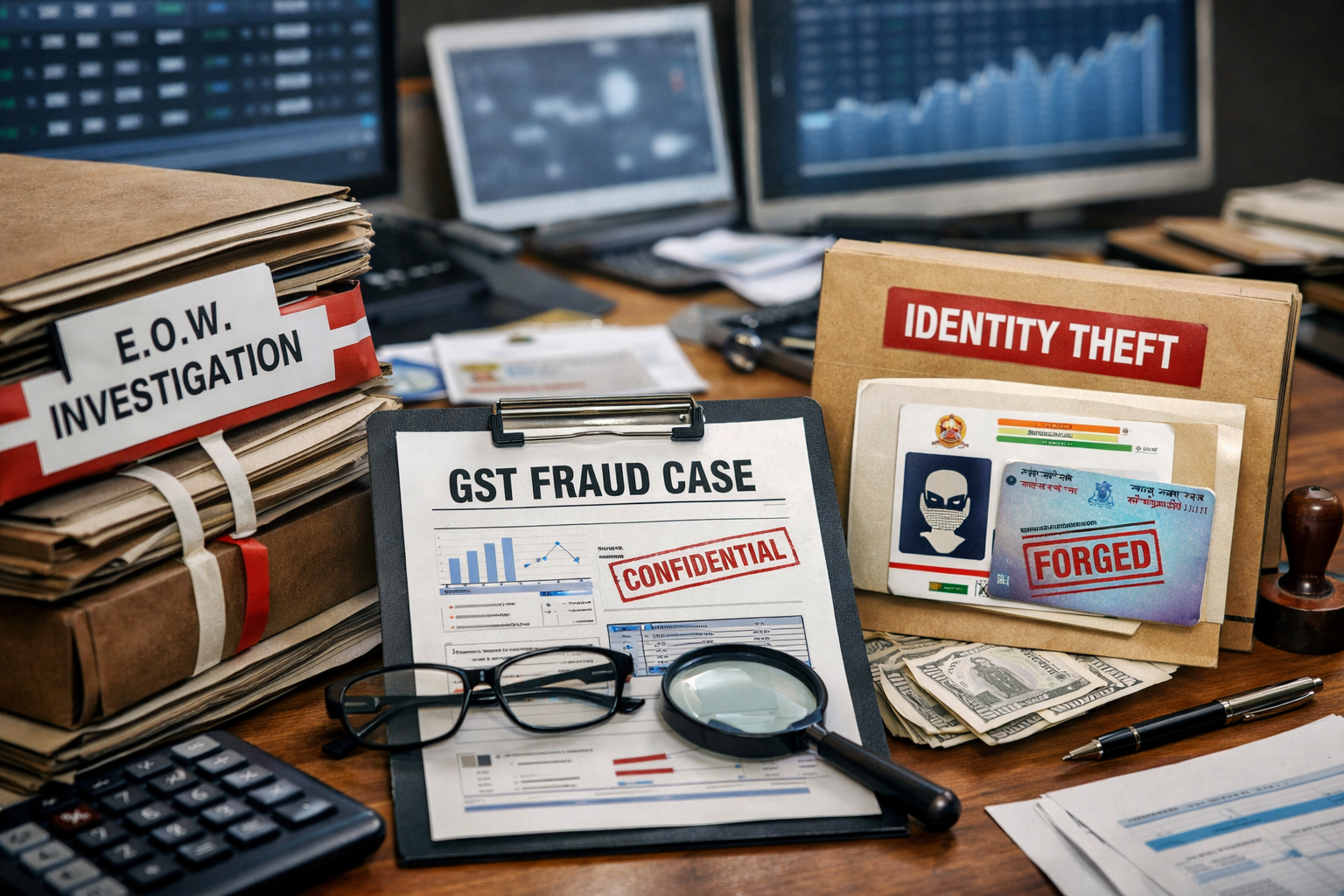

The Economic Offences Wing is investigating seven major GST fraud cases in which identity theft was allegedly used to siphon off ₹374 crore, according to officials familiar with the probe. The cases highlight how stolen or misused personal identities are increasingly being used to enable large-scale tax fraud, investigators said.
Authorities confirmed that the investigations are at different stages, with multiple shell firms, fake invoices, and layered financial transactions currently under scrutiny.
The cases involve the alleged creation of fraudulent GST-registered firms using stolen or misused identity documents. These entities were then allegedly used to generate fake invoices, claim illegitimate input tax credit (ITC), and route funds through several bank accounts to obscure their origin.
Investigators believe many of these firms existed only on paper, making early detection difficult until anomalies were flagged during audits or intelligence-led checks.
Officials said identity theft plays a central role in modern GST fraud networks. Personal details such as PAN, Aadhaar, and address proofs are allegedly misused to register firms without the knowledge of the individuals whose identities are compromised.
In many cases, victims discover the misuse only after receiving tax notices or summons, often months or even years after the fraudulent activity has taken place.
Experts point out that GST fraud through fake entities has become a persistent nationwide challenge. Factors contributing to this include ease of digital registration, forged documentation, complex invoice chains, and delays in real-time detection.
Once fake firms are deregistered or abandoned, tracing the actual beneficiaries becomes significantly more difficult, officials said.
Authorities clarified that ₹374 crore is an estimated tax loss identified so far during the investigation, not a final or adjudicated amount. The figure may be revised as the probe expands and additional transactions are examined.
It does not indicate recovery or conviction, and legal outcomes will depend on the strength of evidence presented before the courts.
Beyond the financial loss to the exchequer, identity theft carries serious consequences for innocent individuals. Victims may face tax notices, questioning by authorities, and prolonged legal processes to establish that they had no role in the fraudulent activity.
Officials stressed that once identity misuse is established, victims are not treated as accused, but acknowledged that the experience can still be distressing and time-consuming.
The EOW is coordinating with GST authorities and banks to trace fund flows, map invoice trails, and identify the individuals controlling the shell firms. Cross-verification of GST databases with banking and identity records is underway to detect repeat misuse patterns.
Officials indicated that additional cases could surface as data-matching continues, particularly if the same identities or contact details are found linked to multiple firms.
As investigations progress, the EOW is expected to file detailed charge sheets once evidence is consolidated, after which courts will determine the next steps, including trials or further inquiries. Parallel efforts are also underway to block compromised identities from being reused in fresh GST registrations.
For businesses and individuals, the cases signal tighter enforcement and closer scrutiny of identity-linked financial crime. Anyone who receives unexpected tax communication or notices unfamiliar GST registrations linked to their PAN is advised to act promptly, as early reporting can prevent deeper legal complications.
The cases underscore a broader shift in economic crime, where identity theft has moved beyond cyber scams to become a core tool in organised financial fraud. For enforcement agencies, the challenge lies in balancing ease of doing business with safeguards against misuse. For citizens, it reinforces the importance of monitoring and protecting personal and business identity data.
The Economic Offences Wing is probing seven GST fraud cases where identity theft was allegedly used to create fake firms, generate fraudulent invoices, and claim illegitimate tax credits, causing an estimated loss of ₹374 crore.
Investigators say personal details such as PAN, Aadhaar, and address proofs were misused to register GST firms without the knowledge of the individuals involved, allowing fraudsters to operate shell companies on paper.
The amount reflects an estimated tax loss identified so far during the investigation. It is not a final figure and does not indicate recovery or conviction.
No. Once identity misuse is established, such individuals are treated as victims, not accused. However, they may still need to cooperate with authorities to clear their records.
In many cases, individuals become aware only after receiving tax notices, GST communications, or summons related to firms they never operated.
Experts point to digital registrations, forged documents, delayed detection of fake invoice chains, and the use of multiple bank accounts as factors that fraudsters exploit.
Authorities are cross-verifying GST, banking, and identity data to trace fund flows, flag compromised identities, and block repeat misuse. Investigations are also being expanded to identify larger networks.
Yes. Officials have indicated that additional cases may surface as data-matching and pattern analysis continue across databases.
They should immediately check GST registrations linked to their PAN, respond promptly to any official notices, and report suspected misuse to tax authorities or the police.
The cases show how identity theft has evolved into a major tool for organised economic crime, affecting not just government revenue but also innocent individuals whose documents are misused.
Part of the NCR Guide editorial team, covering news, real estate, food and lifestyle across Delhi NCR.
Join thousands of Delhi NCR residents who start their day with our morning brief — top stories, real estate updates, events and deals.