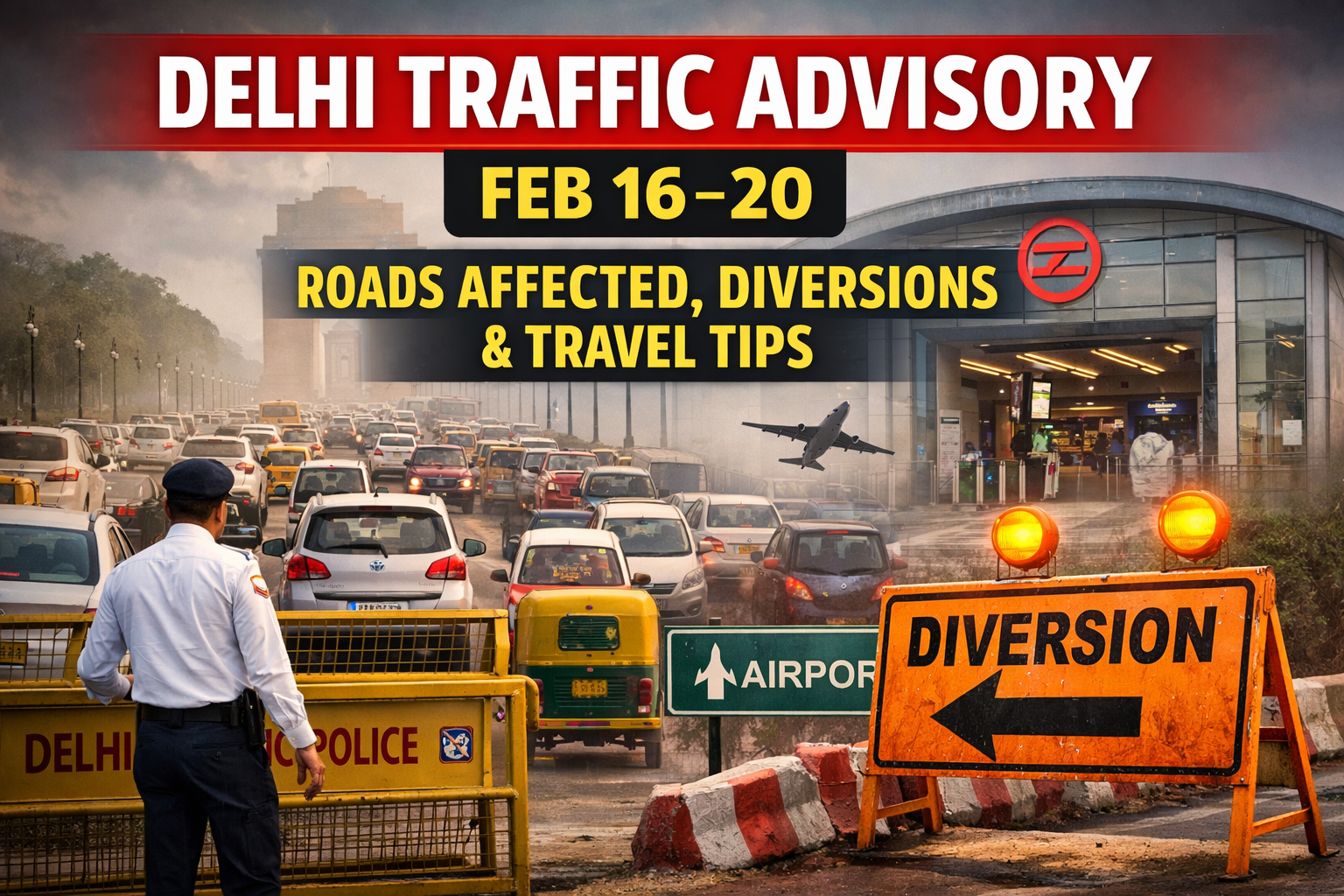

Commuters across the capital are advised to plan travel carefully between February 16 and 20, as movement restrictions and traffic diversions will be in place in parts of Delhi due to scheduled events and related security arrangements. The advisory, issued by the Delhi Traffic Police, highlights regulated movement on select arterial roads during specific time windows.
If you travel daily for work, school, airport transfers, or intercity routes, here is a structured and location-wise breakdown to help you plan ahead.
The temporary measures are linked to scheduled public events and security protocols in the capital. Such advisories typically involve controlled movement near high-security zones, event venues, and major corridors that connect central Delhi with other parts of the city.
Restrictions are date-bound and expected to apply only within the Feb 16–20 window unless extended through a fresh notification.
While movement is not completely suspended, regulated traffic flow and congestion are expected in the following zones:
Roads surrounding government buildings, event venues, and ceremonial routes may see restricted access at intervals. Expect slow movement near key roundabouts and intersections in central districts.
As primary connectors between North, South, West, and East Delhi, these corridors may experience spillover congestion during peak hours. Commuters are advised to check live conditions before entering high-density stretches.
Those travelling toward Indira Gandhi International Airport via NH48 should factor in buffer time, particularly during morning and evening rush hours. Movement may slow due to temporary regulation on feeder roads.
Based on advisory patterns and typical Delhi traffic flow, congestion is most likely during:
• Morning rush: 8 AM to 11 AM
• Evening peak: 4 PM to 8 PM
Where possible, plan departures outside these windows or consider alternate routes.
The Delhi Traffic Police may implement rolling diversions depending on ground conditions. While exact diversion routes can change dynamically, commuters are advised to:
• Use Outer Ring Road if central stretches are congested
• Opt for parallel arterial roads where available
• Avoid event-centric areas unless necessary
• Rely on live navigation tools for updated route suggestions
Traffic regulation may not be uniform throughout the day and could intensify closer to event timings.
As per available information, services by the Delhi Metro Rail Corporation are expected to operate as scheduled. However, entry and exit gates at certain central stations may be regulated temporarily for crowd management.
For airport-bound passengers, the Airport Express Line remains one of the most reliable alternatives to road travel during congestion periods.
DTC buses operating on affected corridors may also experience delays depending on diversion implementation.
Passengers heading to IGI Airport should:
• Leave at least 30 to 45 minutes earlier than usual
• Monitor live traffic updates before departure
• Consider Metro Airport Express where feasible
Interstate bus routes departing from ISBT terminals may encounter minor delays if approaching through regulated corridors.
Plan for additional travel time and avoid central Delhi during peak advisory hours.
Daily routes should be reviewed for congestion-prone intersections.
Allow sufficient buffer time and check flight reporting instructions carefully.
Expect potential surge pricing during heavy congestion periods.
The advisory applies between February 16 and February 20. Unless a new notice is issued, traffic flow is expected to normalize after this period.
Commuters are encouraged to stay updated through official Delhi Traffic Police announcements and real-time navigation platforms.
The advisory has been issued by the Delhi Traffic Police in view of scheduled events and related security arrangements. Temporary movement regulation is being implemented in select parts of the city during this period.
Central Delhi corridors, sections of Ring Road and Outer Ring Road, and routes leading toward Indira Gandhi International Airport may experience slower movement during peak hours.
No. Most roads are not fully closed, but traffic may be regulated or diverted temporarily depending on security and event schedules.
Traffic is expected to be heaviest between 8 AM–11 AM and 4 PM–8 PM. Commuters are advised to plan travel outside these windows where possible.
Services operated by the Delhi Metro Rail Corporation are expected to run normally. However, entry or exit gates at certain central stations may be regulated for crowd control.
Airport travellers should allow at least 30–45 minutes of additional travel time and monitor live traffic updates before departure.
There has been no announcement of school or office closures in connection with the traffic advisory.
Commuters should follow official Delhi Traffic Police advisories and use live navigation apps for real-time traffic conditions.
Part of the NCR Guide editorial team, covering news, real estate, food and lifestyle across Delhi NCR.
Join thousands of Delhi NCR residents who start their day with our morning brief — top stories, real estate updates, events and deals.