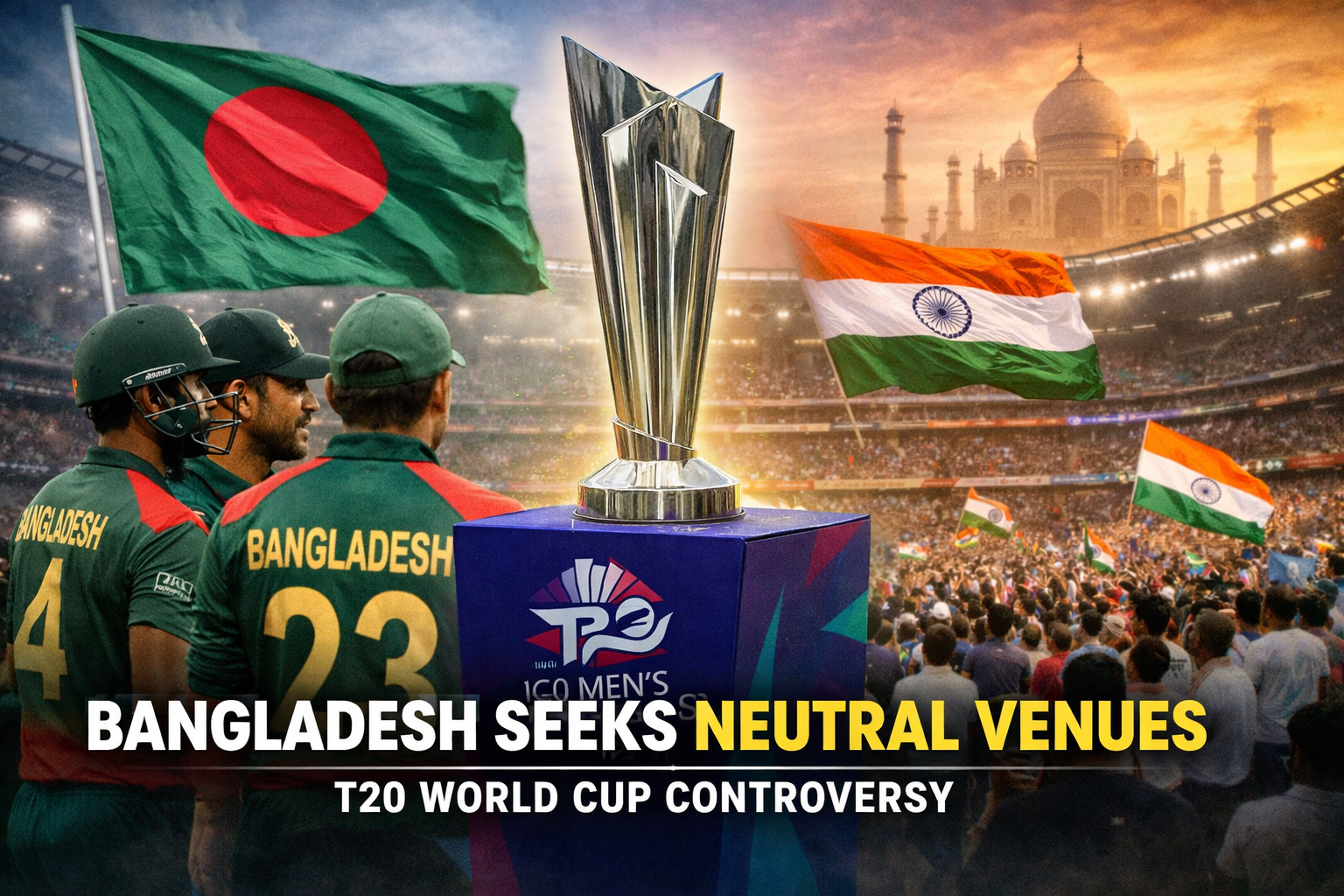

Bangladesh’s participation in the upcoming ICC Men’s T20 World Cup has come under focus after the country’s cricket board formally raised concerns about travelling to India. The request has placed organisers under pressure and once again highlighted how international cricket is influenced by geopolitical realities beyond the field.
The Bangladesh Cricket Board has asked that its T20 World Cup fixtures be moved from India to neutral venues, with Sri Lanka identified as the most practical alternative. The board has pointed to player safety and the prevailing diplomatic environment as the central reasons behind the move.
Officials in Dhaka have stressed that the request is precautionary in nature and not intended as a protest. According to the board, ensuring the security and mental well-being of players and staff must take precedence during a high-profile global tournament.
The International Cricket Council is currently assessing Bangladesh’s submission. While no formal decision has been announced, discussions are underway to explore possible scheduling or venue adjustments that would allow Bangladesh to compete without disrupting the tournament’s competitive balance.
The ICC has previously adopted flexible hosting arrangements in response to political or security challenges, including the use of neutral venues in past global events. Those precedents are likely to play a role in the current deliberations.
India is scheduled to host the bulk of the tournament across multiple major venues. The host board, the Board of Control for Cricket in India, has not issued a detailed public response to Bangladesh’s request so far.
Any decision to relocate matches would require coordination between the ICC, the BCCI, broadcasters, and local authorities. Such changes could affect match schedules, ticketing plans, and operational logistics, particularly for fixtures expected to draw strong regional and international interest.
This situation reflects a broader trend in global cricket, where administrative decisions are increasingly influenced by diplomatic relations and domestic political considerations. In South Asia, cricket remains closely tied to national identity, making such matters especially sensitive for boards and governments alike.
For tournament organisers, the challenge lies in balancing legitimate security concerns with the need to maintain fairness, consistency, and credibility in global competitions.
If Bangladesh’s matches are shifted to Sri Lanka, the World Cup would effectively operate across multiple countries, adding logistical complexity while preserving full participation. If a compromise cannot be reached, the ICC may face pressure to enforce hosting agreements more strictly, a step that could trigger wider debate within the cricketing community.
For now, all stakeholders appear focused on finding a workable solution that keeps attention on the cricket rather than off-field disputes.
The Bangladesh Cricket Board has raised concerns around player safety and the prevailing diplomatic environment. Based on these factors, the board has formally requested that its matches be played outside India at neutral venues.
Sri Lanka has been cited as the most suitable neutral option. The country has hosted major international tournaments in the past and already has infrastructure that can support World Cup matches on short notice.
No final decision has been announced. The International Cricket Council is currently reviewing the request and holding discussions with all stakeholders, including the host board and broadcasters.
At this stage, Bangladesh has not announced a boycott. The board has positioned its request as precautionary and is awaiting the ICC’s response before outlining any further steps.
If Bangladesh’s matches are moved to Sri Lanka, the tournament would operate across multiple countries. This would increase logistical complexity but is unlikely to impact the core structure of the competition.
Yes. Neutral venues have been used in previous global tournaments due to political or security concerns. Pakistan, for example, has played World Cup matches outside host nations in earlier editions under similar circumstances.
As the host nation’s governing body, the Board of Control for Cricket in India would need to coordinate with the ICC on any venue changes, including scheduling, ticketing, and operational arrangements.
The ICC is expected to clarify its position closer to the tournament scheduling deadline. Until then, discussions are ongoing to reach a resolution that allows full participation without disrupting the event.
Part of the NCR Guide editorial team, covering news, real estate, food and lifestyle across Delhi NCR.
Join thousands of Delhi NCR residents who start their day with our morning brief — top stories, real estate updates, events and deals.