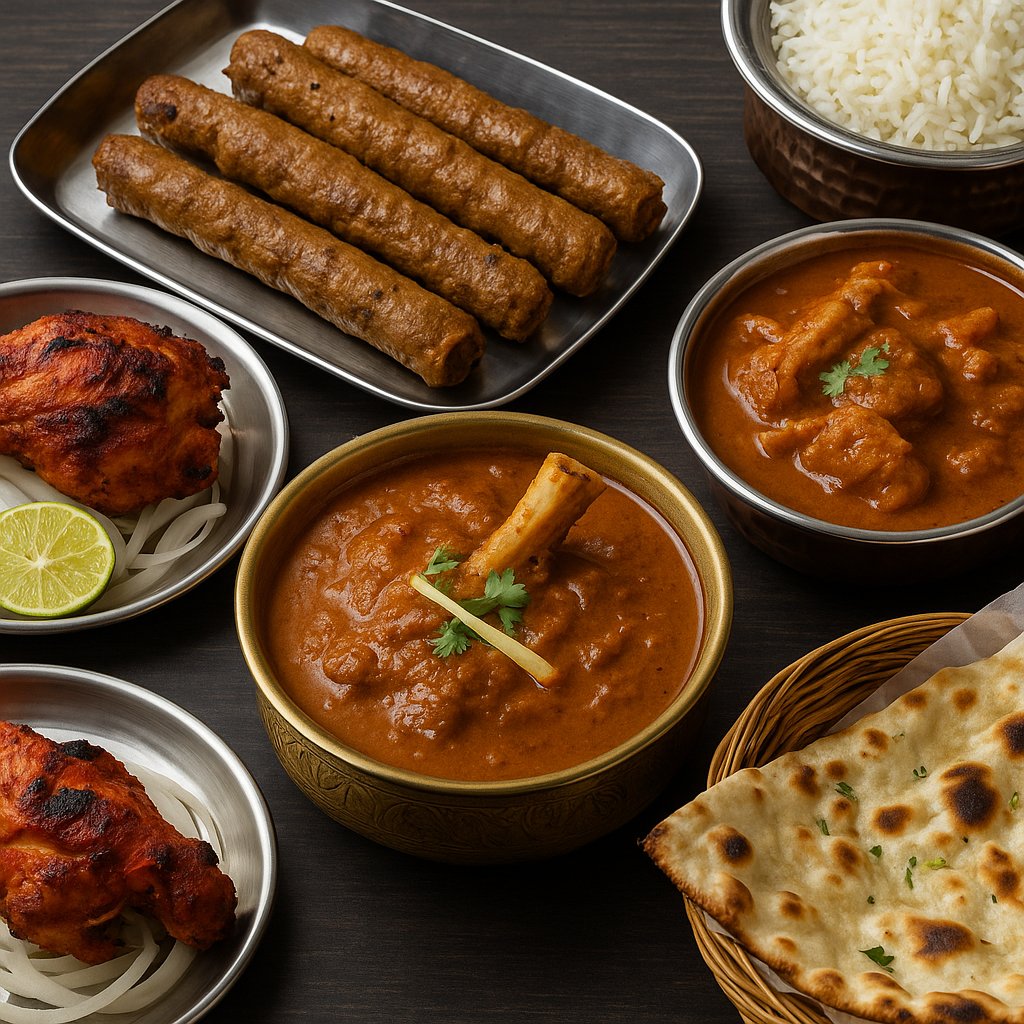

Long before Delhi became a sprawling metropolis with cafes and cloud kitchens, the lanes around Jama Masjid were already serving the kind of food that defined India’s non-vegetarian heritage. Influenced by centuries of Mughal culinary evolution, these backstreets are where time has stood still in the best way possible. Here, the aroma of slow-cooked nihari, tandoor-charred kebabs, and thick, ghee-rich gravies define the daily rhythm. It’s not just a meal — it’s a ritual.
Veteran food critic Pushpesh Pant once said, “If Mughal cuisine has a true capital in India, it’s these 400 yards around Jama Masjid.”
You can’t talk about non-veg food in Delhi without starting at Karim’s. Established in 1913 by Haji Karimuddin, a cook in the royal Mughal court, this eatery began with the idea of serving “royal food to the common man.” Over a century later, it still lives up to that promise.
The mutton burra here is smoked perfection, the brain curry is silken and rich, and their roomali rotis are soft enough to fold around history. Tourists often make it their first stop, but for Delhiites, it’s a rite of passage.
The late chef Floyd Cardoz once remarked in an interview, “Karim’s is where you go to understand what real Mughlai should taste like.”
Often overshadowed by its more famous neighbor, Al Jawahar offers a serious challenge to Karim’s in both flavor and fanbase. Many Old Delhi purists even swear by it as the better of the two.
Its nihari — especially when had with khamiri roti early in the morning — has developed a cult following. The kaleji gurda (liver and kidney) fry is a spice bomb, and the biryani here leans on the rustic, meaty side, with a gravy base soaked into every grain.
One Redditor wrote, “Al Jawahar’s nihari on a winter morning is Delhi soul food. No Michelin star can match that warmth.”
Tucked into a chaotic alley near Jama Masjid, Aslam Chicken has become an icon in its own right — not for traditional butter chicken, but for its unholy hybrid of grilled chicken soaked in molten butter.
There’s no tomato gravy, no cream swirl — just a full chicken, cooked on coal, chopped into chunks, and drowned in liquid white butter before being tossed with a dry spice mix. It’s greasy, indulgent, and something you either love instantly or never recover from.
Anthony Bourdain never visited here, but many feel he would have said: “This is butter chicken for pirates.”
A little further down from Gate 1 of Jama Masjid, Qureshi is where Delhi’s kebab royalty hang out after dark. Their mutton seekh kebabs are smoky, juicy, and delicately spiced, while the boti kebabs — marinated for hours — carry an unmatched depth of flavor.
Locals often compare Qureshi with Khan Chacha, and most agree: if you want kebabs that feel like they’re fresh off the charcoal, this is where you go.
Late-night regulars swear by the Qureshi combo — two seekhs, one roti, and a splash of mint chutney.
For those willing to wake up before sunrise, Haji Shabrati’s nihari is a quiet legend. Located in a discreet bylane near Jama Masjid, this shop opens before dawn and serves only one thing — nihari slow-cooked overnight in large degs, finished with bone marrow and served piping hot.
Unlike commercial versions, Shabrati’s nihari is deeper in color, heavier in aroma, and unapologetically traditional. You’ll often find old Delhiites, rickshaw pullers, and food bloggers all breaking bread together in the same cramped space.
One food historian once wrote, “This is not just breakfast — this is centuries of cooking wisdom in a single clay bowl.”
We trawled through threads on r/Delhi and foodie forums — and here’s what they had to say:
Others also recommended timing your visits with Ramzan night markets or combining food walks with nearby heritage walks in Chandni Chowk and Daryaganj.
For generations, Al Jawahar has stood as a living monument to Old Delhi’s culinary pulse. Named after India’s first Prime Minister and situated right next to the Jama Masjid, this restaurant is synonymous with mutton korma, nihari, and brain curry — cooked in massive degs with deep, complex gravies that seem to trap centuries of spice memory.
“Sunday mornings are for nihari at Al Jawahar — it’s not just food, it’s ritual,” says Farhan Khan, a marketing executive and Old Delhi native.
Their tandoori rotis, slightly charred on the edges and pillowy in the middle, pair beautifully with the slow-cooked meat. This place isn’t about innovation — it’s about preservation, and that’s exactly what makes it iconic.
Hidden in the lanes of Connaught Place, Bhape Da Hotel is a haven for homesick Punjabis and butter chicken loyalists. Don’t let the no-frills ambiance fool you — the food here hums with soul.
Their mutton curry is fiery and luscious, while the butter chicken skips the excessive sweetness that plagues more commercial versions. “It’s the kind of butter chicken I grew up eating in Amritsar,” notes Chef Rahul Dua of Delhi Gastronomy Review.
And then there’s the keema kaleji — an underrated gem that regulars whisper about. It’s deeply spiced, deeply nostalgic, and very, very Delhi.
At Aslam Chicken near Jama Masjid, the experience starts with the sizzle and smoke. Whole chickens are marinated, grilled to charred perfection, and then drowned — yes, drowned — in molten ghee laced with garam masala.
“It’s chaos. It’s over-the-top. But it’s glorious,” says food writer Tanya Ahuja.
What sets Aslam apart isn’t just the excess but the balance. Under the ghee lies perfectly crisp skin, tender flesh, and a depth of spice that doesn’t get lost in the fat. It’s indulgence without apology — and best enjoyed standing shoulder to shoulder with food hunters who won’t eat kebabs anywhere else.
Ask any Delhi local where to get authentic seekh kebabs, and one name repeats: Ghalib Kabab Corner in Nizamuddin. The setup is minimal, the service brisk, but the kebabs — soft, smoky, and spiced just right — are the real draw.
Pair them with roomali roti, mint chutney, and silence — because good kebabs need reverence.
“This is where I take friends visiting from out of town. No fancy decor, just the best mutton seekh this side of Delhi,” shares Arjun Mehta, a travel content creator.
Nestled near Chanakyapuri, Al Kauser is less chaotic than its Old Delhi counterparts, but the food packs no less punch. Their galouti kebabs melt like velvet on the tongue — a result of the precise Awadhi-style marination and use of tenderizers like raw papaya.
Don’t skip the mutton kakori rolls — grilled skewers wrapped in crisp parathas, they’re a favorite with embassy staff and diplomats who often dine discreetly here.
“Some of the most refined kebabs in the city — rich without being greasy, spicy without being harsh,” notes culinary historian Aneesha Bhatnagar.
At the ITC Maurya, Bukhara isn’t just a restaurant — it’s a rite of passage. Heads of state, celebrities, and purists alike gather here not for dainty plating, but for robust, primal North-West Frontier cuisine.
There are no forks or knives. You tear, dip, and devour. The dal Bukhara, slow-cooked overnight, is as famous as the Sikandari raan — a whole leg of lamb marinated in secret spices and roasted till the meat barely holds onto the bone.
“Every serious foodie must experience Bukhara at least once — if only to understand how bold simplicity can taste like luxury,” says award-winning food critic Kunal Vijayakar.
Set right opposite the Jama Masjid, Qureshi Kabab is easy to miss — unless you follow the scent of charcoal smoke and cloves. For years, this tiny corner has turned out tandoori boti kebabs and shami kebabs that have become part of Old Delhi folklore.
There’s no menu. Just point, pay, and trust the guy behind the grill. “I’ve eaten kebabs in Lucknow, Hyderabad, even Istanbul,” says travel writer Pratik Singh, “but few match the depth of Qureshi’s spice and the char on their mutton boti.”
Everything is fire-cooked. Everything is honest. It’s street food, but with generational precision.
For those craving a modern twist on tradition, Indian Accent at The Lodhi is where molecular gastronomy meets murgh malai. Chef Manish Mehrotra’s tasting menus have reimagined non-veg classics into artful bites — think blue cheese naan with butter chicken reduction or pulled pork phulka tacos.
It’s upscale, yes — but never pretentious. The ingredients remain familiar, the execution global. “It’s like eating your memories, upgraded for 2025,” says restaurateur Sunaina Khurana.
Every bite is curated. Every dish is rooted in nostalgia — just reframed in poetry.
Tucked away in South Delhi’s Defence Colony, Colonel’s Kababz has quietly built a cult following. Their Afghani chicken — subtly spiced, generously creamy — is a standout, as are the chicken gilafi kebabs, sheathed in capsicum and coriander.
It’s family-run, consistent, and fast becoming a weekday dinner habit for many. Locals swear by their tandoori soya chaap too — a veg surprise from a hardcore non-veg haven.
“This is where you go when you want something reliable, indulgent, and still not mainstream,” says Delhi-based photographer Naina Kapoor.
On the chaotic GTB Road, Changezi Chicken blazes with fluorescent signs and the unmistakable aroma of slow-cooked meat in rich gravy. Their signature dish, chicken changezi, is smoky, tangy, and intensely spiced — a true North Delhi-style comfort meal.
Most meals here end with mutton stew or bhuna gosht, best soaked up with thick khamiri rotis or rumali. “This is hardcore Dilli — bold, unapologetic, and satisfying to the bone,” laughs Shubham, a DU student who’s been a regular since school days.
You don’t go to Jung Bahadur for a menu. You go for one thing: deep-fried kachoris dunked in a bowl of soulful mutton curry, cooked with whole spices and a liberal splash of desi ghee. Hidden near Gali Paranthe Wali in Chandni Chowk, this tiny spot doesn’t scream for attention — but the regulars? They queue up like clockwork.
“Call it kachori or call it a vessel for some of the best meat curry in Delhi — I don’t care. Just give me two plates,” said one regular, somewhere between a tear and a smile.
This is food that feels personal. Generous, messy, and made with devotion.
Located off the Mehrauli-Gurgaon Road, Jungli Mohal is a revelation. It’s one of the few places in Delhi that experiments with lesser-seen meats like quail (bater), duck, and occasionally rabbit — prepared in rustic masalas and wood-fired tandoors.
The vibe is semi-jungle, semi-private club — and no, it’s not on Zomato.
“Eating quail here reminded me of my grandfather’s hunting trips in Uttar Pradesh,” says Rajnish, a retired Army officer. “Except now it’s legal, ethical, and better spiced.”
Perfect for diners who want to go off-script without losing flavor.
Inside Champa Gali’s minimalist lanes sits Café Dori, where pork belly confit and slow-roasted chicken sandwich share the menu with Balkan sausages and pastrami.
Their pulled pork croissant and chicken schnitzel strike the perfect balance between Instagram and integrity — beautifully plated, yet hearty and bold on the palate.
What makes Dori stand out is their commitment to craft. Everything — from the meats to the bread — feels deliberate. A favorite among expats, creatives, and Delhi’s evolving food intelligentsia.
Inspired by Lucknowi kitchens, Naushijaan delivers royal Awadhi gravies and kebabs in a warm, understated setting. With outlets in Greater Kailash and Noida, their galouti kebabs, mutton korma, and nehari pack in slow-cooked nuance that’s increasingly rare in Delhi’s fast-food landscape.
Their dum biryani is layered with ghee-soaked rice and saffron, enveloping the meat like a secret. “This is not just dinner, it’s a memory of a city,” said Shaista, a Lucknow native and food historian.
Tucked into a corner of Adchini, Rustom’s brings Parsi comfort food to Delhi’s table. Think Salli Boti, Mutton Dhansak, and Kolmi na Curry — all served on banana leaves in a setting that feels half-colonial, half-family home.
Their flavors are sweet-sour-spicy in just the right proportions. The kind of food that tells stories with each bite.
“I didn’t know I missed Parsi food until I came here,” quipped Anya, a Bombay-born architect now based in Hauz Khas. “This feels like a lunch at your bawa friend’s house, but better plated.”
You could be broke, hungover, in love, or just done with life — but if you’re near Lajpat Nagar past midnight, Moolchand Paratha has a way of making everything feel bearable.
What most people miss beyond the famous anda and aloo parathas is their keema-loaded mutton paratha, slathered with butter and served with pickled onions.
“After 2 AM, this is not food — it’s therapy,” said an Uber driver who’s been stopping here for 12 years.
Expect no seating, lots of honking, and some of the most comforting non-veg street food Delhi has to offer.
Late-night tandoori chicken and roomali rolls are practically a subculture in Delhi. Drive down Rajouri Garden, Batla House, or even the quieter lanes of Subhash Nagar, and you’ll find tandoors glowing red at 1 or 2 AM.
Try Al-Bake’s chicken shawarma (NFC), Sharma Tandoori Hut (Rajouri), or the lesser-known Baba Chicken Corner near Bhogal — where the fish tikka is spicy, smoky, and best eaten with charred rumali.
This is Delhi’s post-sunset pulse. Raw, loud, and lip-smacking.
You know Changezi Chicken even if you haven’t eaten it. The dish — a spicy, creamy, slow-cooked meat curry — has its own legacy. And Changezi Chicken Restaurant, tucked away in Karol Bagh and later expanded across Delhi, is still the one to beat.
Their Changezi mutton, served late into the night, tastes like the kitchen refused to take shortcuts. “We still use the same degchi,” says the owner. “No gravies are frozen. If it’s not stirred for 3 hours, it doesn’t go out.”
It shows.
Walk into Matia Mahal Lane after 11 PM and you’re in a different world. The lanes are quieter, the smoke thicker, the meats more intense.
At Al-Jawahar, even at 1 AM, you’ll find trays of mutton biryani, nihari, and tandoori raan ready to go. Just across, Qureshi Kabab Corner still sells melt-in-mouth buff seekh kebabs with a touch of lemon and that signature rumali.
“You come here for taste, not TikTok,” said Aamir, who’s run a kebab cart nearby since 1996. “This is meat the way our fathers made it — slow, spicy, and no sugar-coating.”
Near IFFCO Chowk and MG Road, under the flyovers and by the side lanes, a network of biryani vans, Anda curry stalls, and small dhabas quietly operate till 4 AM.
Look for HungerStrike Xpress, Biryani Baba, and the nameless van near MG Road metro that serves buff curry, chicken changezi, and egg bhurji roll that packs more flavor than some 5-star buffets.
These aren’t Google-rated spots. They’re word-of-mouth legends that survive on repeat customers and nothing else.
In pockets of CR Park, Alaknanda, and Kalkaji, Bengali home chefs run quiet weekend operations — no advertising, just word-of-mouth. The star of the show? Kosha Mangsho (slow-cooked mutton in mustard oil, with caramelized onions and green cardamom), paired with luchi or steamed rice.
“Food is not just about taste; it’s memory,” says Trina Dey, who runs a small kitchen from her second-floor flat in CR Park. Her Sunday orders fill up by Friday. She’s been cooking for the same 100+ customers for years — never missed a weekend.
There’s no app. You DM her, and she sends you a menu.
Some of the best Kashmiri non-veg food in Delhi isn’t from the few commercial restaurants — it’s from homes. Like Kitchen of Kinara, run from a family house in Vasant Kunj, where mutton rogan josh, yakhni, and tabak maaz are made using recipes that go back generations.
“We don’t tweak for Delhi taste,” says the owner, Shazia. “If you want the real thing, it comes with mustard oil, time, and patience.” Orders close by Thursday for weekend slots, and they only serve 30-50 people per day.
Their wazwan is slow food at its truest — hand-ground spices, earthen pots, and zero shortcuts.
In areas like Rajinder Nagar, Noida Sector 50, and Green Park, a new wave of Instagram-based biryani sellers are redefining trust-based delivery. They announce the menu in Stories (Hyderabadi, Calcutta, or Lakhnawi), open a slot for 2 hours — and within 20 minutes, it’s sold out.
One of them, Biryani by Amina, based in East Delhi, makes a Calcutta-style mutton biryani that’s light, aromatic, and always comes with a perfectly boiled aloo and runny raita.
“She doesn’t use rose essence. No food color either. Just good rice, meat, and heart,” a regular once commented in a Reddit Delhi thread.
Several delivery-only spots — often hiding behind aggregator platforms — have quietly become non-veg legends in their own right.
No gimmicks. Just big flavor, smart pricing, and chefs who cook for the palate, not the photo.
In every lane, apartment complex, and colony of Delhi, someone’s nani, ammi, or mashi is still cooking the food they grew up with. They don’t always call themselves “chefs.” Some never even call it a business. But when they cook — mutton rezala, Andhra pepper chicken, Bohri raan — you taste decades of memory in every bite.
These are the kitchens that remind you: non-veg food in Delhi isn’t just a dish — it’s storytelling on a plate.
Some iconic names include Karim’s in Jama Masjid, Moti Mahal in Daryaganj, Rajinder Da Dhaba in Safdarjung, and Qureshi Kabab Corner in Nizamuddin. These places have stood the test of time, with generations of Delhiites vouching for their consistent flavor, affordability, and cultural significance.
Moti Mahal in Daryaganj is widely regarded as the birthplace of butter chicken. However, other noteworthy spots include Gulati in Pandara Road Market and Have More nearby. For a slightly modern twist, Dhaba – Estd 1986 and Punjab Grill also serve up rich, smoky renditions.
Yes, popular areas like Jama Masjid, Chandni Chowk, and Matia Mahal are relatively safe till late evening. However, it’s best to visit in small groups and stay alert. The culinary experience is worth it, especially during Ramadan or festive evenings.
For authentic Mughlai cuisine, head to Al Jawahar and Karim’s near Jama Masjid, Bade Mian in Ballimaran, or Zam Zam in Okhla. These eateries stick to traditional recipes and often have generations-old culinary legacies.
Yes. Hidden gems like Al Kauser in Chanakyapuri, Ashok & Ashok Meat Dhaba in Sadar Bazar, and Kitchen of Awadh in Sarita Vihar have niche followings. These are often run by seasoned cooks or families preserving forgotten recipes.
Try Rajinder Da Dhaba, which runs late into the night, or AIIMS Bhawan Lane kebab stalls. Al Kauser and Khan Chacha in Khan Market also serve till late. For a true local experience, some vendors near Jama Masjid stay open past midnight during festive seasons.
Definitely. Qureshi Kabab Corner, Tundey Kababi in Ghalib Road, Bhaijaan Kebabs in Batla House, and Kale Baba ke Kabab in Sadar are beloved for their seekh, galouti, and shami kababs. These joints often serve melt-in-the-mouth delicacies with spicy mint chutney.
Street food is often spicier, smokier, and served fast — think kebabs, rolls, and tandoori chicken. Restaurant dishes are more refined, with richer gravies and controlled spices. Both styles are equally beloved in Delhi’s food culture.
Yes, a first-timer’s non-veg food trail in Delhi should include:
A mix of guided food walks in Old Delhi, local recommendations via Reddit and food blogs, and trial-and-error with app reviews like Zomato or Google Maps is ideal. Going with a local friend or foodie increases the chances of discovering authentic places.
Absolutely. In areas like Jama Masjid, Batla House, Sadar Bazar, and Zakir Nagar, you can enjoy a full meal (roti, kebabs, korma) for under ₹200. Even in South Delhi, dhabas like Rajinder Da Dhaba offer solid value for money.
It can be, but many places offer milder options or adjust spice levels if requested. Upscale restaurants tend to tone down spice automatically. If you’re sensitive, it’s best to start with butter chicken or grilled kebabs.
Top non-veg hubs include:
These zones have clusters of iconic eateries, each with its loyal fan base.
Part of the NCR Guide editorial team, covering news, real estate, food and lifestyle across Delhi NCR.
Join thousands of Delhi NCR residents who start their day with our morning brief — top stories, real estate updates, events and deals.