
Preparing for the CM Shri School Admission Test is not about studying more, but studying in the right direction. With rising competition and limited seats, students need a clear plan that builds conceptual understanding, improves speed, and reduces exam pressure.
This guide brings together everything that matters, including the latest syllabus focus, best books, and a preparation strategy that actually works for Class 6 and Class 8 aspirants.
The CM Shri Admission Test is a competitive entrance exam designed to assess whether a student is ready for a higher academic standard.
It focuses on concept clarity, logical thinking, and the ability to apply knowledge, rather than simple memorization. Students who understand concepts and can solve unfamiliar questions tend to perform better.
The exam typically covers Mathematics, Science, General Knowledge with Reasoning, and Language Skills.
Mathematics evaluates problem-solving ability and numerical understanding, including topics like fractions, algebra, and geometry.
Science checks conceptual clarity and observation skills, often based on everyday applications of physics, chemistry, and biology.
General Knowledge and Reasoning measure analytical thinking and awareness, including puzzles, patterns, and logical sequences.
Language skills focus on reading comprehension, grammar, and vocabulary, which are essential for overall academic performance.
For Class 6, the paper focuses on strong fundamentals and basic reasoning, but questions still require clarity.
By Class 8, the level becomes more analytical, with deeper concepts and higher-level reasoning, especially in Mathematics and Science.
The transition is gradual, but students who practice application-based questions early have a clear advantage.
Many students rely only on school textbooks and struggle because the exam tests more than just syllabus completion.
The right books help students understand how questions are framed, improve problem-solving speed, and build familiarity with exam patterns. They also reduce confusion by keeping preparation focused instead of scattered.
A combination of NCERT fundamentals, admission guides, and mock tests works best.
Students do not need too many books. A few reliable resources used consistently are more effective.
Popular and useful options include CM Shri admission guides for Class 6 and 8, R. Gupta’s preparation books, and Ramesh Publishing House guides. Practice papers and mock test series are equally important for exam readiness.
The key is not the number of books, but how well they are used.
Preparation becomes easier when it follows a clear structure.
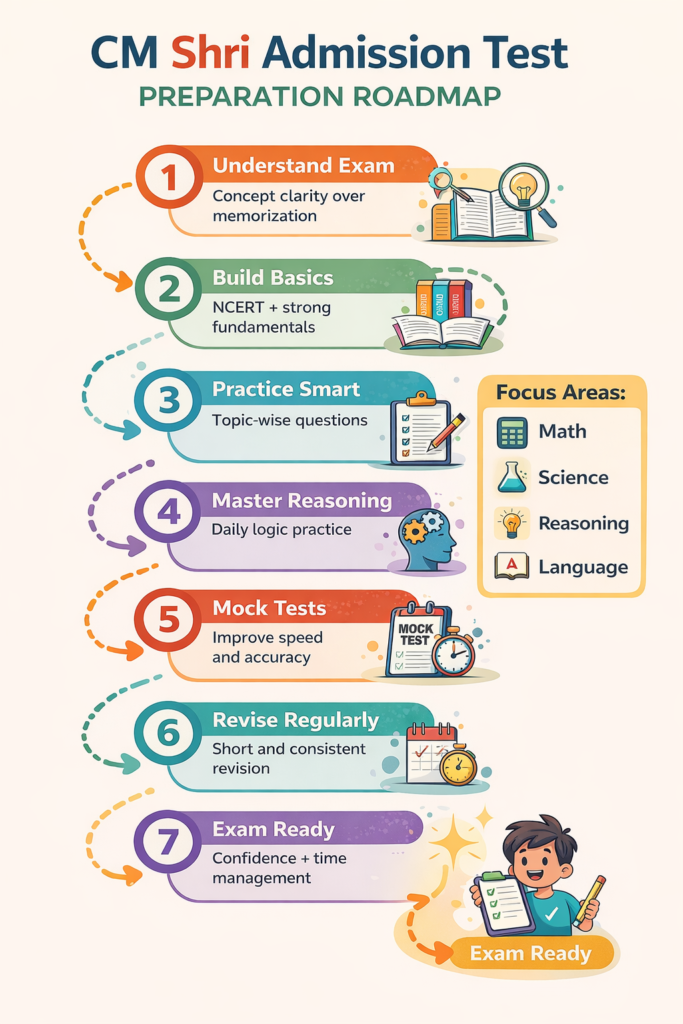
Start by building strong basics using NCERT textbooks from the current and previous class. Once concepts are clear, move to admission test guides for application-based questions.
Practice should be regular and topic-wise. After completing each chapter, solving questions and revisiting difficult ones helps strengthen weak areas.
Mock tests play a crucial role. They improve time management, reduce exam anxiety, and help students understand their performance under pressure.
Revision should be consistent, not rushed. Short, regular revision sessions are far more effective than last-minute preparation.
A balanced and consistent routine works best for most students.
Studying for two to three focused hours daily, mixing subjects, and taking short breaks helps maintain concentration. Regular revision and weekly self-assessment ensure steady progress.
Consistency is far more important than long study hours.
One common mistake is focusing only on theory without practicing enough questions. Another is avoiding mock tests, which leads to poor time management during the exam.
Students also tend to postpone difficult topics, which creates pressure later. Addressing weak areas early makes preparation smoother and more effective.
Parents can help by ensuring consistency and reducing stress during preparation.
Tracking progress weekly, encouraging reading habits, and maintaining a balanced routine can make a significant difference. A supportive environment often improves both confidence and performance.
Success in the CM Shri Admission Test depends on clear concepts, regular practice, and a disciplined approach. Students who focus on understanding rather than memorizing, and who practice consistently, are better prepared for the exam.
No. NCERT books build the foundation, but additional practice through admission guides and mock tests is necessary to handle exam-level questions.
Most students perform well with 2 to 3 hours of focused study per day, supported by regular revision.
Preparation should ideally begin 6 to 8 months before the exam to allow enough time for practice and revision.
Yes. Mock tests are essential for improving speed, accuracy, and exam confidence.
The exam is manageable for students with strong fundamentals, but it becomes challenging for those who rely only on memorization.
Part of the NCR Guide editorial team, covering news, real estate, food and lifestyle across Delhi NCR.
Join thousands of Delhi NCR residents who start their day with our morning brief — top stories, real estate updates, events and deals.