
As Delhi introduces its new “CM Shri Sarvodaya Vidyalayas” (CM Shri Schools), parents across the city are asking a crucial question: How do these compare to regular Delhi government schools? Whether you’re making an admission decision or simply curious about the future of public education in the capital, understanding the real differences can help clarify your next step.
This comparison breaks down the key distinctions across academics, infrastructure, pedagogy, faculty, and opportunities — backed by government data, student testimonials, and expert insights.
Launched in 2023 under the Delhi Government’s “Education Revolution 2.0,” CM Shri Sarvodaya Vidyalayas are modern, model schools designed to elevate the quality of public education. These are not private schools — they are free government schools but with enhanced infrastructure, global-level design, and specialized programs.
“CM Shri Schools aim to set a new benchmark in public education by integrating world-class learning environments with inclusive access,”
— Education Department, GNCTD
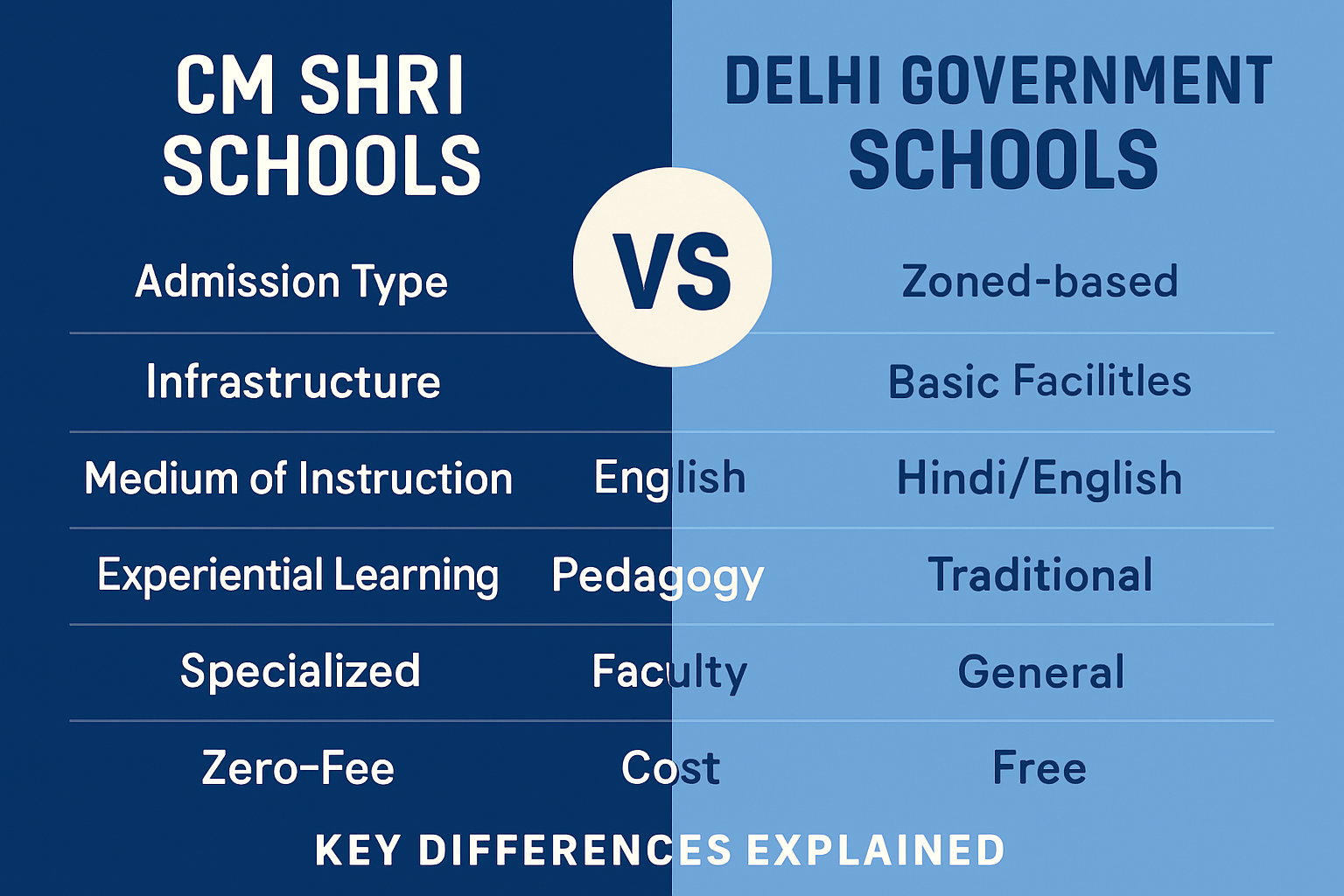
Here’s a side-by-side comparison table to clearly understand how these schools differ:
| Aspect | CM Shri Sarvodaya Vidyalayas | Regular Delhi Government Schools |
|---|---|---|
| Admission Type | Lottery-based (open to all) | Zoned-based (based on locality) |
| Infrastructure | Smart classrooms, robotics labs, libraries, AC auditoriums, elevators, barrier-free access | Basic classrooms, limited lab facilities, non-AC |
| Faculty Selection | Dedicated, specially trained teachers from the DoE’s elite pool | General DoE faculty |
| Curriculum & Pedagogy | Blend of NCERT + 21st-century skills, entrepreneurship mindset, STEAM focus | Primarily NCERT-based teaching |
| Languages Offered | Hindi, English, Sanskrit | Hindi, English, some regional languages |
| Technology Integration | AI-enabled learning, digital boards, robotics and innovation labs | Basic digital aids (where available) |
| Extracurriculars | Music studios, art rooms, indoor sports arenas | Standard physical education and arts (where facilities exist) |
| School Timings | Single-shift, full-day schedule | Double shift in many schools |
| Focus Areas | Leadership, innovation, global citizenship | Traditional academic excellence |
| Parent Engagement | Workshops, regular reports, digital tracking apps | PTMs, manual reports |
| Uniform & Books | Free, upgraded design and quality | Free but basic quality |
| Campus Design | Modern architecture, climate-resilient buildings | Traditional concrete blocks |
“I never imagined a government school could have a robotics lab or a 3D printer. My daughter now teaches me coding terms!”
— Anita Sharma, parent, CM Shri School in Moti Nagar
“Earlier, I used to study in a school with broken benches and ceiling fans. Now we sit in smart classrooms with ACs and digital boards.”
— Amaan, Class 7 student
Note: Seats at CM Shri Schools are limited and filled via public lottery — make sure to apply early when forms are released.
For parents looking for admissions, syllabus, or official information:
CM Shri Schools are newly launched by the Delhi government with enhanced infrastructure, specialized curriculum, and English-medium education from nursery onward. In contrast, regular government schools follow the standard state board curriculum and often lack the same level of facilities or international exposure.
Yes, CM Shri Schools are completely free for students. Like regular government schools, there are no tuition fees. However, the admission process is merit-based and may involve entrance tests or interviews depending on the level.
CM Shri Schools follow the curriculum designed by the Delhi government in alignment with the Delhi Board of School Education (DBSE), which allows more flexibility and innovation compared to traditional CBSE schools.
Yes, eligible students from private or other government schools can apply for CM Shri Schools during the admission window. However, competition is high, especially for middle and secondary levels.
Yes, all CM Shri Schools offer English-medium instruction from the foundational level (nursery). This is a key differentiator from regular Delhi government schools, where the medium often shifts from Hindi to English only in later classes.
These schools offer advanced facilities like smart classrooms, well-equipped science labs, art and music studios, reading lounges, and even international collaboration opportunities — features that are often missing or limited in regular government schools.
CM Shri School teachers undergo specialized training, often in collaboration with institutions like Delhi SCERT, DoE, and international education bodies. While regular government school teachers are also qualified, the training for CM Shri educators is more intensive and modern in approach.
The CM Shri curriculum includes experiential learning, coding, life skills, and digital literacy, along with standard academic subjects. It’s more aligned with global education trends, unlike the more traditional curriculum in standard Delhi government schools.
Yes, CM Shri Schools are designed to have more optimal student-teacher ratios compared to regular schools, which improves individualized attention and overall learning outcomes.
Yes, due to the limited number of seats and high demand, the admission process can be competitive. Entry at certain classes may involve an aptitude test or shortlisting process, unlike regular government schools which offer more open admission policies.
The Delhi Government has announced plans to expand CM Shri Schools across every zone, with a target of 100+ such schools in the next phase. They are intended to become flagship models for public education reform.
Part of the NCR Guide editorial team, covering news, real estate, food and lifestyle across Delhi NCR.
Join thousands of Delhi NCR residents who start their day with our morning brief — top stories, real estate updates, events and deals.