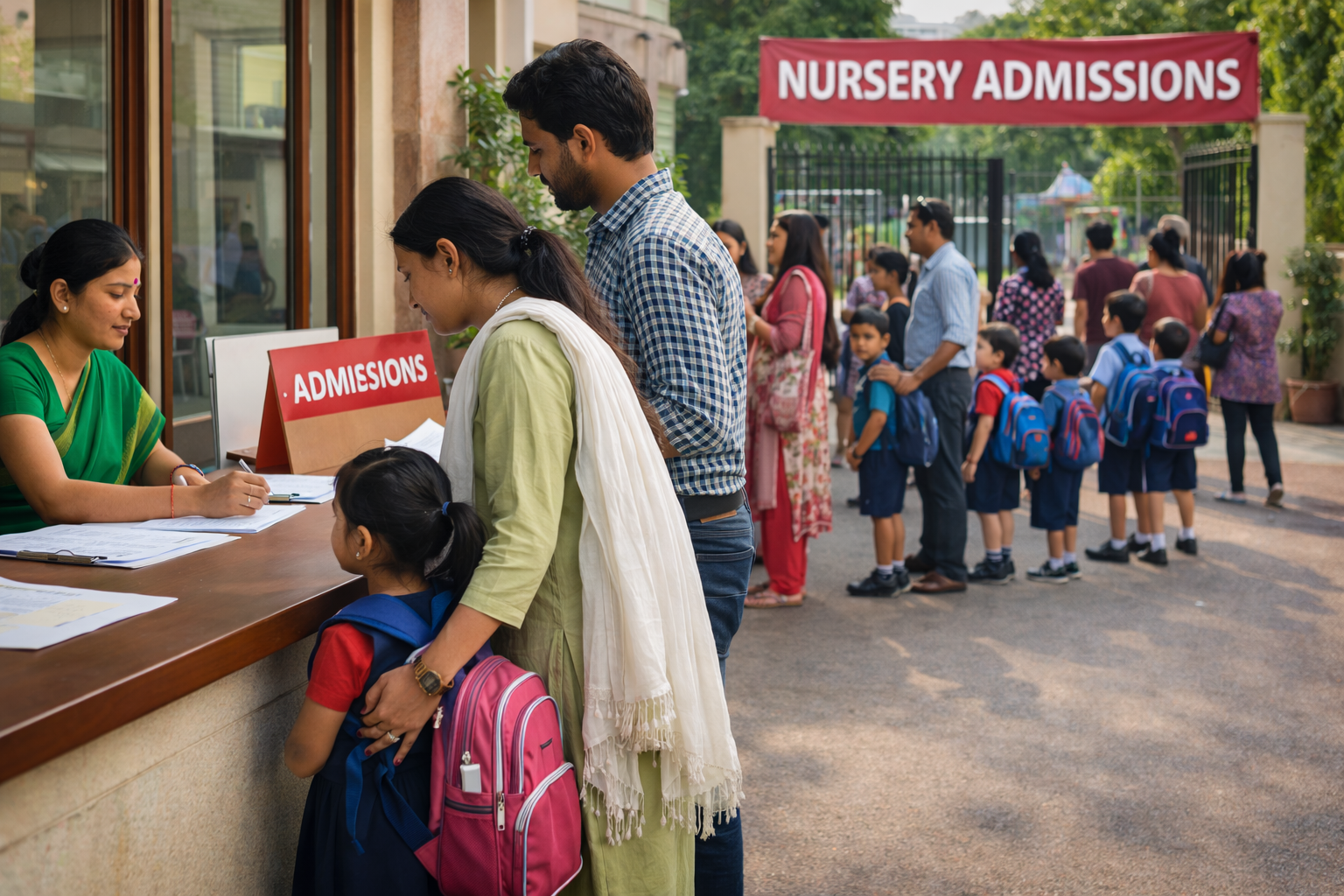

With the nursery admission cycle for the 2026 academic session approaching, parents in Delhi are beginning preparations well in advance. While official admission schedules and school-wise criteria will be notified later by the Directorate of Education, the basic eligibility rules and documentation framework remain largely consistent each year.
This guide explains what parents should prepare early, which documents are typically required, and how to avoid common mistakes that can impact nursery admission applications.
Nursery admissions in Delhi apply to private unaided recognised schools, not government-run schools. These schools follow guidelines issued by the Directorate of Education but are allowed to frame their own admission criteria, usually through a point-based system.
Common criteria include residential distance from the school, sibling studying in the same institution, alumni status of parents, and in some cases, single-parent or girl-child considerations. Competition is high, especially in popular neighbourhood schools, making accurate documentation critical.
For nursery admission, children are generally required to be at least three years old as on the cut-off date specified by the school or the DoE. While the exact cut-off date may vary slightly, age eligibility is strictly enforced.
Parents should verify age criteria carefully for each shortlisted school, as even minor discrepancies in birth records can lead to rejection.
Most Delhi schools ask for a standard set of documents. Preparing these early helps parents avoid last-minute issues once applications open.
Child-related documents usually include a municipal birth certificate, recent passport-size photographs, and Aadhaar card if available. Parent-related documents typically include Aadhaar cards or valid photo IDs and proof of relationship with the child.
Residence proof is especially important and may include Aadhaar cards with current address, voter ID, passport, electricity or water bills, property tax receipts, or a registered rent agreement.
Schools are particularly strict about address proof, as it directly affects distance-based points.
Distance from the school often carries the highest weightage in the admission process. Schools calculate distance using road distance, aerial distance, or ward-based mapping.
Parents must ensure that the address mentioned across all documents matches exactly. Mismatched or recently changed addresses are among the most common reasons for disputes and application rejections.
Apart from standard documents, schools may require additional paperwork such as self-declaration forms, affidavits for sibling or single-parent status, or alumni proof for parents who studied at the same school.
Each school publishes its own checklist, so parents should rely only on official school websites or notice boards, not assumptions based on previous years.
Many nursery admission applications fail due to avoidable errors rather than ineligibility. These include uploading unclear or cropped documents, submitting mismatched address proofs, missing school-specific forms, or assuming all schools follow identical rules.
Each application should be treated as a separate process, even when applying to multiple schools in the same locality.
As of now, official nursery admission dates for 2026 have not been notified. School-wise point criteria lists are also awaited, and no changes to the admission framework have been formally announced.
Parents should treat current preparation as readiness planning, not final submission.
Experienced parents recommend shortlisting schools within realistic distance ranges, keeping multiple photocopies and digital scans ready, tracking official notices from schools and the Directorate of Education, and avoiding last-minute corrections to documents.
Early preparation allows parents to focus on accuracy and choice rather than urgency once the admission window opens.
Nursery admission in Delhi is not just about meeting eligibility requirements. It is about precision, documentation, and timing. With thousands of applications competing for limited seats, even small errors can affect outcomes.
Being prepared early gives parents clarity, confidence, and flexibility during the actual admission process.
The official nursery admission schedule for the 2026 academic session is expected to be notified later by the Directorate of Education. Parents are advised to monitor official DoE notifications and school websites regularly.
Children applying for nursery are generally required to be at least three years old as on the cut-off date specified by the school or the Directorate of Education. Exact cut-off dates may vary slightly by institution.
The guidelines apply to private unaided recognised schools in Delhi. Government schools do not admit children at the nursery level under this process.
Yes. Distance from the school is one of the most heavily weighted criteria in most admission point systems. Address proof accuracy is therefore critical.
Schools typically require a municipal birth certificate of the child, recent photographs, parent photo ID, and valid residence proof. Some schools may also ask for additional declarations or affidavits.
No. Aadhaar is not mandatory for nursery admission. However, if available, schools may accept it as an identity or address proof.
Mismatch in address details can lead to loss of distance-based points or rejection. Parents should ensure that all submitted documents carry the same current address.
Yes. Parents are allowed to apply to multiple private schools, but each application must be completed separately and accurately according to the school’s specific requirements.
If an application is rejected, parents can check the reason provided by the school, raise objections within the prescribed timeline if applicable, or focus on other schools where applications have been submitted.
As per Delhi government rules, schools are not permitted to conduct interviews of children or parents during the nursery admission process.
Part of the NCR Guide editorial team, covering news, real estate, food and lifestyle across Delhi NCR.
Join thousands of Delhi NCR residents who start their day with our morning brief — top stories, real estate updates, events and deals.