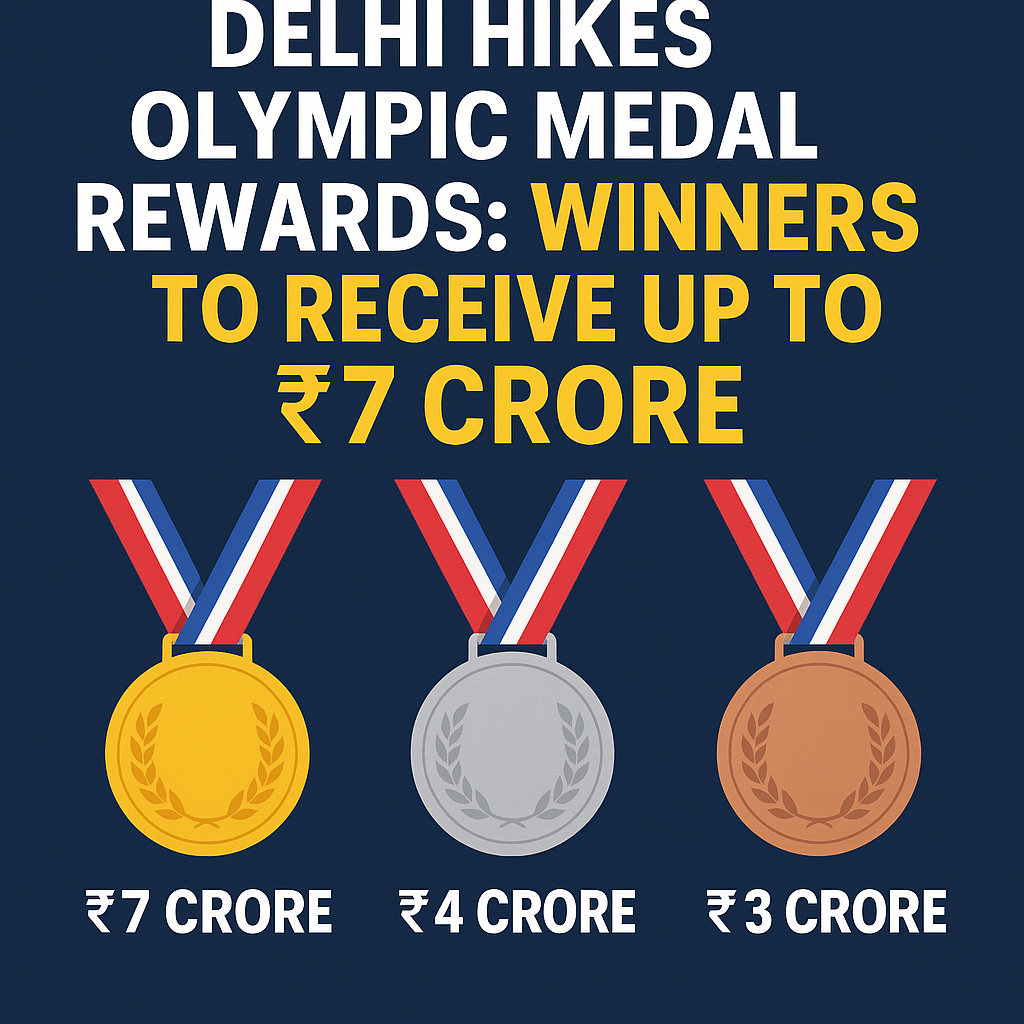

In a landmark move that could redefine the future of sports in the capital, the Delhi Government has increased the cash reward for Olympic gold medal winners to ₹7 crore, making it one of the most generous athlete incentive policies in India. The announcement, made by Chief Minister Arvind Kejriwal on July 21, 2025, has already sparked nationwide conversation—not just for its financial value, but for the deeper shift it signifies in how Delhi intends to build a world-class sporting ecosystem.
This policy is more than a headline. It’s a strategic declaration: Delhi wants to lead India’s Olympic ambitions.
The updated reward structure now promises:
This is a significant increase over the previous rewards (₹3 crore for gold, ₹2 crore for silver, ₹1 crore for bronze) and places Delhi in line with or above leading sports-forward states like Haryana, Punjab, and Odisha.
It isn’t just about prize money—this is part of a broader strategic push to position Delhi as India’s premier sporting capital, both in recognition and in readiness.
CM Kejriwal, addressing a group of internationally performing athletes at a recent event, said:
“Olympic medals are not won in one day—they are built over years of sacrifice, failure, and discipline. Our athletes deserve nothing less than the country’s full respect, and this reward is a step toward acknowledging that.”
The announcement wasn’t made in isolation. It’s part of a long-term vision that includes investment in grassroots infrastructure, high-performance coaching, and a strong emphasis on sports education.
The government is investing in 12 new world-class sports complexes, each designed to host Olympic-grade training. These aren’t basic stadiums—they’ll include:
These complexes will be accessible to both elite athletes and local youth, a dual model aimed at cultivating talent from the grassroots while preparing current champions for international arenas.
The Delhi Sports University is a game-changer for Indian sports. Unlike traditional institutions, this university will focus entirely on:
This initiative seeks to eliminate the “either-or” dilemma athletes face between academics and sports careers, offering integrated learning and Olympic preparation under one roof.
Acknowledging that behind every champion is a mentor who rarely gets the spotlight, Delhi will also reward coaches of Olympic medal-winning athletes. While the exact figures are being finalized, the gesture marks an important shift in how training ecosystems are valued—not just outcomes.
Additionally, plans are underway for:
While Haryana has historically led the way in terms of both athlete development and reward policies, Delhi’s updated ₹7 crore figure now places it among the top reward-offering states in India.
| State | Gold Reward | Silver Reward | Bronze Reward |
|---|---|---|---|
| Delhi (2025) | ₹7 crore | ₹4 crore | ₹3 crore |
| Haryana | ₹6 crore | ₹4 crore | ₹2.5 crore |
| Odisha | ₹6 crore | ₹4 crore | ₹2.5 crore |
| Punjab | ₹2.25 crore | ₹1.5 crore | ₹1 crore |
| Maharashtra | ₹1 crore | ₹75 lakh | ₹50 lakh |
Delhi’s policy not only competes at the top but also includes long-term infrastructure and education plans, making it more holistic than pure cash disbursement.
Delhi’s move isn’t just about catching up with other states—it’s a reflection of the capital’s aspiration to create its own athlete identity. Historically, many top athletes have hailed from Haryana, Punjab, or the southern states. But with increasing investments in coaching, school-level talent identification, and urban infrastructure, Delhi is quickly reshaping its own narrative.
Already, Delhi-based athletes have begun making waves at international competitions like the Asian Games, Commonwealth Games, and Youth Olympics. With this new reward policy, the city sends a clear message: our athletes will be celebrated, not just tolerated.
With the Paris Olympics set to begin in July 2024 and Los Angeles 2028 on the global horizon, this reward structure comes at a critical juncture. It’s not just symbolic—it has tangible motivational and logistical value.
Elite athletes can now:
This financial and moral support also addresses a long-standing concern among Indian athletes: the uncertainty of life after sport.
This isn’t expected to be the final step. According to sources within Delhi’s sports department, upcoming reforms may include:
The Delhi Olympic Medal Reward Policy 2025 could very well become the template for a national model, especially if it translates into higher medal tallies and happier, healthier athletes.
The Delhi government has increased the cash reward for Olympic medalists representing Delhi to ₹7 crore for gold, ₹5 crore for silver, and ₹3 crore for bronze. This makes Delhi one of the top-paying regions for Olympic athletes in India.
To be eligible, athletes must be affiliated with Delhi-based sports associations, primarily train or represent Delhi in national events, and fulfill residency or education criteria defined by the government.
Yes. The revised policy includes significant financial rewards for coaches of medal-winning athletes to recognize their role in the athletes’ success.
As of now, the policy focuses on future Olympic events, particularly from Paris 2024 onwards. However, there may be provisions for retrospective recognition in some cases, subject to Delhi government review.
Delhi now matches or exceeds states like Haryana, Odisha, and Punjab in Olympic cash incentives, with one of the highest gold medal rewards in India at ₹7 crore.
Part of the NCR Guide editorial team, covering news, real estate, food and lifestyle across Delhi NCR.
Join thousands of Delhi NCR residents who start their day with our morning brief — top stories, real estate updates, events and deals.