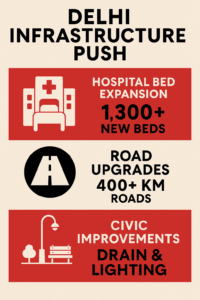

Rekha Gupta has been officially appointed as the Chief Minister of Delhi, marking a crucial moment in the city’s governance. With BJP reclaiming control from AAP, her administration is expected to emphasize urban infrastructure, municipal coordination, and economic development. Her appointment signals a strategic shift in governance, with BJP aiming to build long-term voter confidence in Delhi.
Historically, BJP has struggled to gain a stronghold in Delhi’s assembly elections, despite dominating municipal governance through the MCD (Municipal Corporation of Delhi) for several years. The party last held power in Delhi in 1998 under CM Sushma Swaraj, after which it lost ground to Congress and later to AAP. Rekha Gupta’s leadership now represents BJP’s attempt to re-establish itself in Delhi’s urban governance landscape, focusing on infrastructure-led development and administrative efficiency. Rekha Gupta has been officially appointed as the Chief Minister of Delhi, marking a crucial moment in the city’s governance. With BJP reclaiming control from AAP, her administration is expected to emphasize urban infrastructure, municipal coordination, and economic development. Her appointment signals a strategic shift in governance, with BJP aiming to build long-term voter confidence in Delhi.
Gupta’s leadership is expected to focus on policy reforms in transport, education, women’s safety, and economic growth, but with a distinct approach compared to previous administrations. Unlike AAP’s heavy focus on welfare-based initiatives such as free water, electricity, and transport for women, BJP under Gupta aims to balance infrastructure development with targeted social policies. Some of her immediate policy actions include:
This strategic shift highlights BJP’s attempt to redefine governance in Delhi with a development-first, policy-driven approach, moving away from subsidy-heavy governance models while still addressing key social concerns. Gupta’s leadership is expected to focus on policy reforms in transport, education, women’s safety, and economic growth. Some of her immediate policy actions include:
With BJP assuming control, AAP leaders have voiced strong concerns, particularly over the potential rollback of social welfare schemes. In a recent statement, Arvind Kejriwal criticized BJP’s governance approach, calling it a “threat to Delhi’s progress,” and warned that any attempt to dismantle free education, healthcare, and electricity programs would be met with strong resistance.
Deputy Chief Minister Manish Sisodia echoed these sentiments, arguing that “BJP’s model of governance favors the elite while ignoring the common citizen.” He further stated that AAP will take legal and constitutional measures to prevent drastic policy rollbacks.
AAP has outlined a multi-pronged approach to counter BJP’s new administration:
Political analysts suggest that AAP’s aggressive opposition strategy could set the stage for heightened political tensions, as BJP seeks to redefine Delhi’s governance model. With the 2025 Budget announcement approaching, the battle between BJP’s development-focused policies and AAP’s welfare-driven approach is expected to intensify. With BJP assuming control, AAP leaders have voiced strong concerns, particularly over the potential rollback of social welfare schemes. Kejriwal’s party has vowed to:
The upcoming Delhi Budget 2025 under Rekha Gupta’s administration is expected to shift financial priorities towards long-term urban development and economic sustainability. Compared to last year’s budget under AAP, which heavily emphasized free welfare schemes such as electricity subsidies, water bill waivers, and free transport for women, the 2025 budget reflects a shift towards infrastructure investment and economic growth.
This budget signals BJP’s intention to move away from subsidy-heavy governance and towards economic self-sufficiency and infrastructure-led growth. However, opposition leaders argue that cutting back on direct welfare benefits could negatively impact Delhi’s lower-income residents, setting the stage for political debate over the budget’s long-term viability. The upcoming Delhi Budget 2025 under Rekha Gupta’s administration is expected to shift financial priorities towards long-term urban development and economic sustainability. Major budget allocations will focus on:
A key focus of Rekha Gupta’s administration will be streamlining municipal governance and addressing long-standing issues within the MCD. The BJP plans to restructure MCD operations by tackling specific challenges, including:
The goal of these reforms is to modernize Delhi’s municipal services, ensuring better accountability, efficiency, and citizen engagement under the new administration. A key focus of Rekha Gupta’s administration will be streamlining municipal governance. BJP plans to restructure MCD operations by:
With Rekha Gupta now leading Delhi’s government, the city is set for a political and governance transformation. While BJP is expected to focus on urban infrastructure and economic development, the political contest with AAP will shape the capital’s trajectory.
Despite ambitious plans, several challenges could hinder the smooth implementation of these policies:
BJP’s governance in Delhi under Rekha Gupta could set a precedent for urban policy models in other metro cities. If successful, the focus on infrastructure-driven growth and economic sustainability may influence BJP-led governments in cities like Mumbai, Bengaluru, and Hyderabad. Urban centers facing similar challenges with pollution, public transport congestion, and municipal inefficiencies could look to Delhi’s policies as a model for reform. However, the effectiveness of these strategies will largely depend on execution, political stability, and public reception.
The coming months will determine whether Gupta’s leadership brings sustainable change and long-term political stability to Delhi, or if opposition forces and implementation challenges will slow the progress of her administration. With Rekha Gupta now leading Delhi’s government, the city is set for a political and governance transformation. While BJP is expected to focus on urban infrastructure and economic development, the political contest with AAP will shape the capital’s trajectory.
Despite ambitious plans, several challenges could hinder the smooth implementation of these policies:
The coming months will determine whether Gupta’s leadership brings sustainable change and long-term political stability to Delhi, or if opposition forces and implementation challenges will slow the progress of her administration. With Rekha Gupta now leading Delhi’s government, the city is set for a political and governance transformation. While BJP is expected to focus on urban infrastructure and economic development, the political contest with AAP will shape the capital’s trajectory. The coming months will determine whether Gupta’s leadership brings sustainable change and long-term political stability to Delhi.
Part of the NCR Guide editorial team, covering news, real estate, food and lifestyle across Delhi NCR.
Join thousands of Delhi NCR residents who start their day with our morning brief — top stories, real estate updates, events and deals.