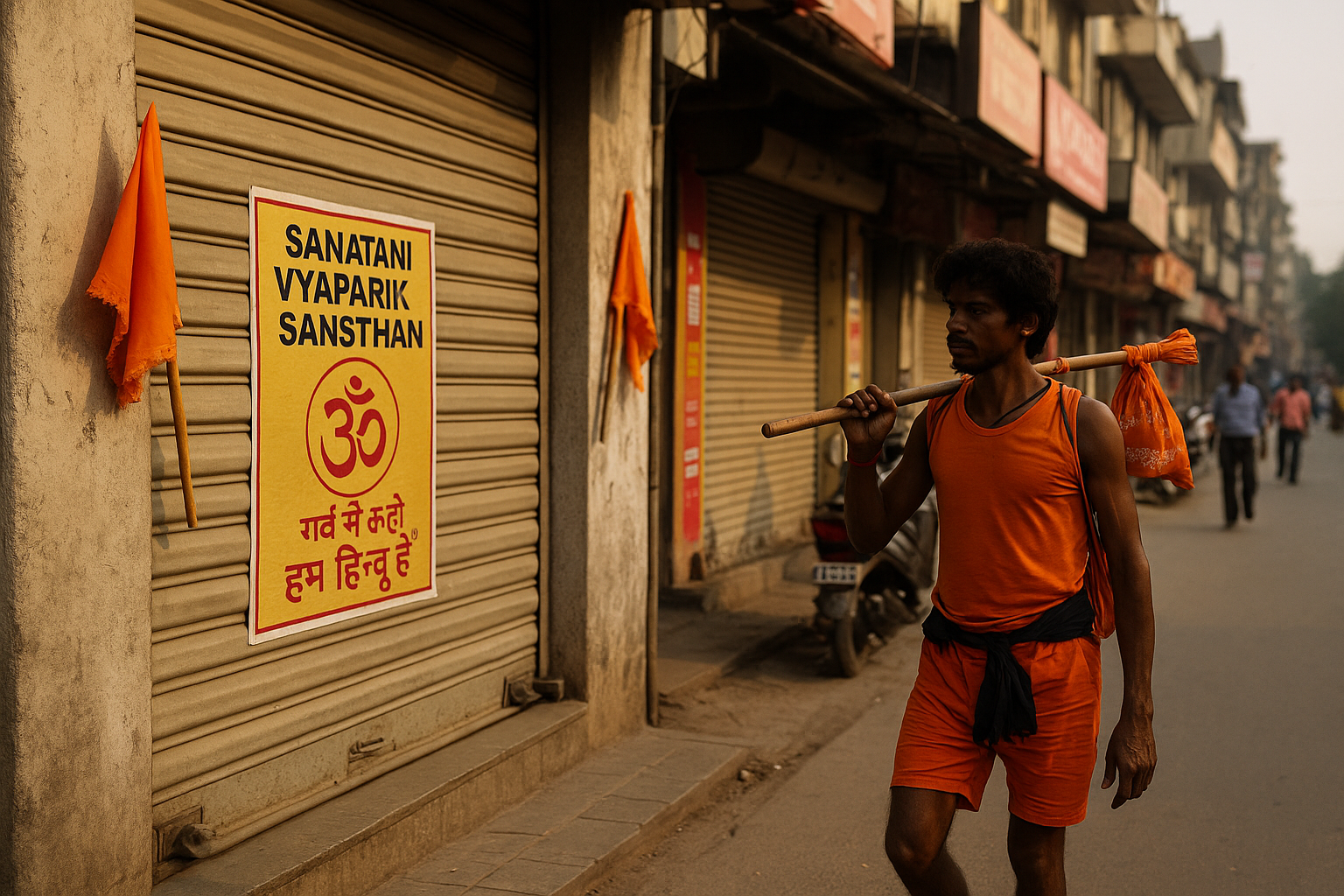

As the Kanwar Yatra picks up across Delhi and northern India, a new kind of label is appearing on shopfronts along the pilgrimage route — “Sanatani Vyaparik Sansthan” stickers. Distributed by the Vishwa Hindu Parishad (VHP), these tags carry the message: “Garv se kaho, hum Hindu hain” — a call to cultural pride and identity. But behind this religious branding lies a broader conversation about food practices, community relations, and the delicate balance between tradition and inclusivity.
In July 2025, VHP volunteers began distributing “Sanatani” certification stickers to shops along the major Kanwar Yatra routes in Delhi, especially in areas like Burari, west Delhi, Najafgarh, and parts of outer Delhi-NCR including Ghaziabad and Noida.
These stickers are granted to shops that serve pure vegetarian food, observe “Sanatan” values, and refrain from selling meat or alcohol. While the VHP frames the campaign as voluntary, many shopkeepers feel indirect pressure to participate, especially as Kanwariyas often seek assurance that food is prepared according to religious expectations.
According to Surendra Gupta, VHP Delhi head and campaign lead, the stickers help Kanwariyas easily identify “pure” establishments aligned with their religious vows.
“These devotees won’t even place their jal on the ground. They need complete purity — physical and spiritual,” Gupta said.
Kanwar Yatra participants typically follow strict spiritual discipline, avoiding meat, alcohol, and anything considered impure. VHP claims these stickers simply help pilgrims find like-minded establishments.
Despite being marketed as a convenience, critics raise key concerns:
The Municipal Corporation of Delhi (MCD) has clarified that no government order mandates sticker usage or meat shop closures during the Yatra. However, public pressure often functions as informal enforcement.
Many Kanwariyas say they look specifically for stickers or saffron flags while choosing where to eat or rest.
“It’s not about politics, it’s about trust. We just want to be sure the food is clean and sacred,”
— Suresh Jangra, Kanwariya resting near Burari
For some, the sticker acts as a spiritual quality seal, not just a brand tag.
In Uttar Pradesh, a different form of labeling is being implemented. The state government has introduced mandatory QR code stickers for eateries along Kanwar routes. These reveal:
Though promoted as a transparency tool, critics say this invites government surveillance, religious profiling, and public judgment.
Some businesses see value in displaying the sticker. “Since we put up the Sanatani label, we’ve had more footfall from yatris,” said a sweets shop owner in west Delhi.
Others are more cautious.
“What if this turns into another excuse to corner us? It’s not illegal to sell what we do, but people might assume the worst if we don’t have a sticker,”
— Restaurant owner in Noida
Experts warn that even voluntary labels can create long-term exclusion.
“Any visible religious categorization of businesses must be viewed with caution. Even if it’s voluntary, it creates the potential for exclusion, bias, or worse — informal enforcement outside legal safeguards.”
— Anjali Deshpande, Constitutional law researcher, Delhi
Some activist groups are monitoring the situation and have indicated potential legal action if evidence of coercion or economic discrimination emerges.
The VHP insists this is a temporary campaign for the Kanwar Yatra season. But many worry that once displayed, such religious markers could become a permanent part of business identity — especially if shopkeepers fear consequences of removing them later.
The bigger concern is whether such practices will normalize religious labeling in public commerce, subtly redrawing social and economic boundaries in India’s pluralistic cities.
These stickers are distributed by the VHP to vegetarian shops along the Kanwar Yatra route, identifying them as aligned with Sanatan Hindu values. They signal religious purity and assure Kanwariyas the food served meets their spiritual standards.
No. There is no official rule requiring shops to display them. The campaign is described as voluntary, though some shopkeepers feel indirect pressure to participate.
Yes, absolutely. Shops are under no legal obligation to participate in any religious certification scheme. Refusing the sticker should not affect their right to operate — although social consequences may vary.
There is no law banning or endorsing religious labeling. However, any such practice that results in discrimination, exclusion, or coercion can be challenged under Indian secular and constitutional principles.
So far, no formal legal complaint has been filed. But activist groups are monitoring the situation closely and may act if evidence of exclusion or intimidation emerges.
In contrast to Delhi’s sticker model, UP has mandated QR-code labels that link to shop licenses, owner identity, and food details. This is a government-backed transparency move — though it, too, faces criticism for privacy concerns.
The VHP claims the campaign is temporary, but many worry the stickers could become a lasting identity marker for shops — with implications that extend beyond the pilgrimage season.
Part of the NCR Guide editorial team, covering news, real estate, food and lifestyle across Delhi NCR.
Join thousands of Delhi NCR residents who start their day with our morning brief — top stories, real estate updates, events and deals.