
Update as on 22 August
New Delhi, August 22 — India’s Supreme Court reversed its earlier directive to remove stray dogs from Delhi and its suburbs, opting instead for a humane and balanced approach following widespread protests and criticism.
On August 11, a bench of Justices J.B. Pardiwala and R. Mahadevan ordered municipal bodies in Delhi, Noida, Gurugram, and Ghaziabad to begin an immediate roundup of stray dogs and relocate them to shelters. The decision was made amid mounting concerns over dog bites and rabies cases, particularly involving children.
(turn0news19)
However, the public backlash—fuelled by animal rights groups, citizens, political leaders like Rahul Gandhi, and activists—prompted the court to reconsider.
In a revised ruling on August 22, a three-judge bench (Justices Vikram Nath, Sandeep Mehta, and N.V. Anjaria) directed the following:
Animal welfare activists and public figures welcomed the new direction:
| Aspect | Details |
|---|---|
| Original Order | Relocation of all stray dogs to shelters across Delhi-NCR |
| Revised Approach | Sterilize, vaccinate, and return dogs; shelter only rabid/aggressive ones |
| New Measures | Ban public feeding; create feeding zones; allow adoption via MCD |
| Policy Scope | Supreme Court to develop nationwide stray dog management strategy |
| Public Reaction | Widely hailed as humane and balanced—support from activists, officials |
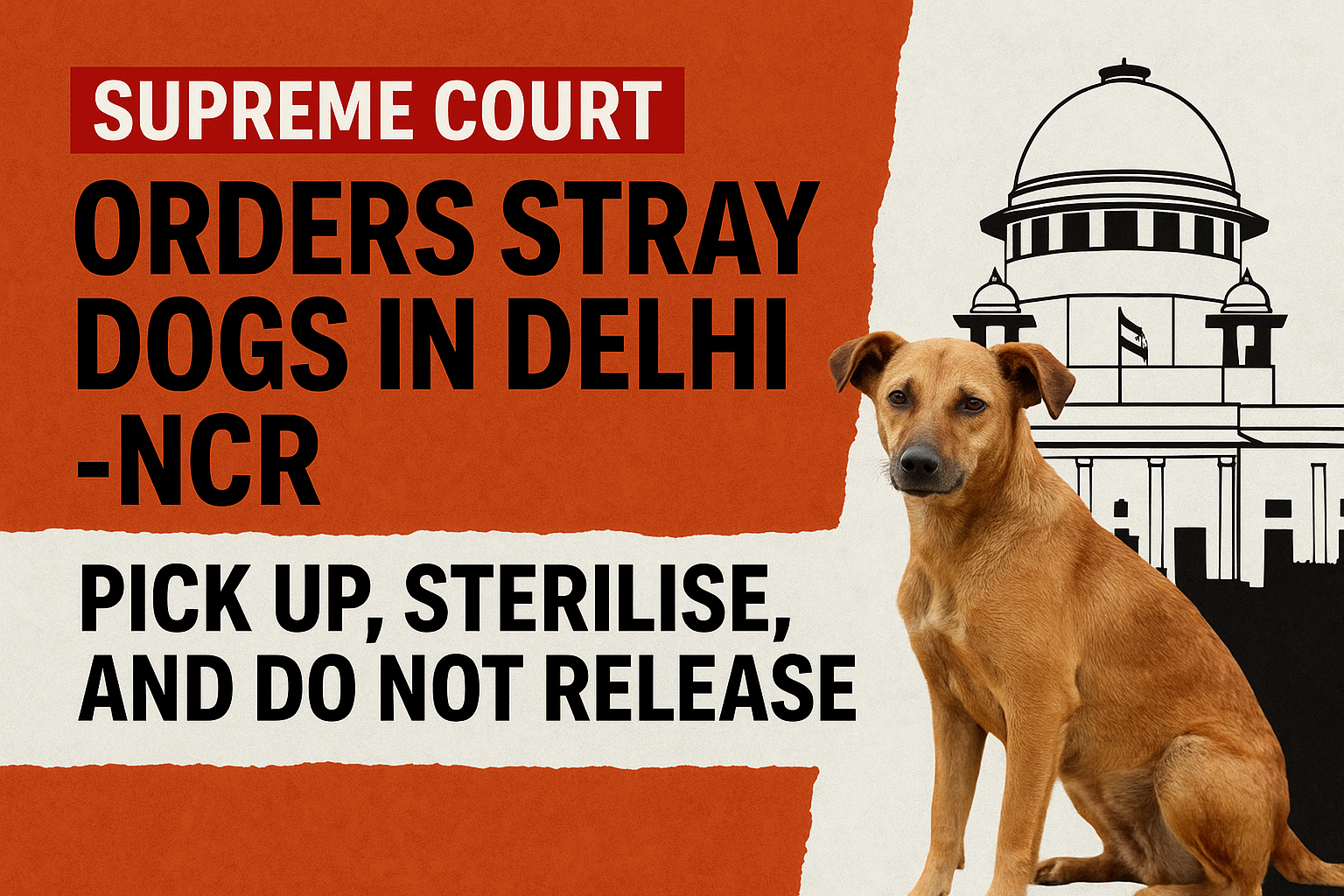
The Supreme Court of India has issued a landmark directive for Delhi-NCR’s municipal and civic bodies: pick up stray dogs, sterilise them, and do not release them back onto the streets. This uncompromising order is intended to address the city’s escalating stray dog population and rising bite cases, while prioritising public safety and humane treatment.
Over the past few years, Delhi-NCR has witnessed a surge in stray dog-related incidents, including severe and fatal attacks. In 2024 alone, Delhi reported over 1.5 lakh dog bite cases, according to official health department data. Residents and local authorities have been at odds over the Animal Birth Control (ABC) Rules, which traditionally allowed sterilised dogs to be released in the same area they were picked up from.
The court observed that this approach had failed to contain the growing threat, prompting a “no compromise” order that shifts focus from relocation to long-term containment.
| Directive | Details | Purpose |
|---|---|---|
| Pick up stray dogs | Municipal bodies must identify and capture strays across Delhi-NCR | Reduce immediate public risk |
| Sterilise | Dogs to undergo ABC-compliant sterilisation and vaccination | Control population growth |
| Do not release | Sterilised dogs to be kept in dedicated shelters instead of returning to streets | Break the cycle of re-proliferation |
| Central monitoring | Delhi-NCR civic bodies to submit regular progress reports to court-appointed committees | Ensure compliance and transparency |
| Public health priority | Public safety and prevention of bites take precedence over territorial release practices | Reduce human-animal conflict |
Under the earlier Animal Birth Control (Dogs) Rules, 2001:
Under the new SC directive:
Comparison Table: Old vs. New Approach
| Criteria | Old ABC Rules | New SC Order |
|---|---|---|
| Post-sterilisation release | Yes, in same locality | No, kept in shelters |
| Stray population control method | Territorial occupancy | Shelter-based removal |
| Impact on public safety | Limited | Potentially higher due to permanent removal from streets |
| Infrastructure needed | Minimal kennels | Large-scale shelters, feeding, medical care |
Delhi-NCR has an estimated 6–7 lakh stray dogs. Current sterilisation capacity across all civic bodies is 30,000–40,000 dogs per year, far below the requirement for population control.
Dog Bite Statistics (Delhi)
| Year | Reported Bite Cases |
|---|---|
| 2021 | ~1,10,000 |
| 2022 | ~1,35,000 |
| 2023 | ~1,50,000 |
| 2024 | ~1,53,000 (projected) |
With the SC order, the gap between sterilisation targets and capacity will need urgent addressing to ensure the directive’s success.
For residents:
For animal welfare:
The Supreme Court’s “pick up, sterilise, do not release” order marks a decisive policy shift in Delhi-NCR’s stray dog management. Its success will depend on how effectively authorities balance public safety, humane treatment, and logistical feasibility. If implemented well, it could become a model for urban animal control across India — but only if backed by robust infrastructure and sustained funding.
On August 11, 2025, the Supreme Court of India directed all municipal bodies in Delhi-NCR to pick up stray dogs, sterilise them, and not release them back onto the streets. This is a departure from the previous Animal Birth Control (ABC) Rules, which required returning sterilised dogs to their original location. The Court cited escalating public safety concerns and rising dog bite cases as the main reasons for this shift.
The Court noted that despite decades of ABC implementation, stray dog populations in urban areas remain high, and dog bite cases have increased — with Delhi NCR seeing thousands of incidents annually. It concluded that releasing sterilised dogs back into public spaces was not effectively reducing risks, especially in densely populated areas.
Exact numbers vary, but estimates put Delhi’s stray dog population between 3–4 lakh (300,000–400,000), with the NCR region combined possibly exceeding 6 lakh. Sterilisation rates have historically covered only a small fraction of this population each year.
The Court has left it to municipal bodies and state governments to arrange for permanent or long-term housing, which could include expanded animal shelters, collaboration with NGOs, or creating dedicated stray dog care facilities. This requirement introduces significant logistical and funding challenges.
As of now, the order is specific to Delhi-NCR, but it sets a precedent that could influence similar petitions or public safety actions in other cities facing high stray dog-related incidents.
The order has sparked debate.
It also raises questions about how this aligns with Section 11 of the Prevention of Cruelty to Animals Act, which protects against unnecessary confinement.
Dogs suspected of rabies will continue to be handled under existing public health and veterinary protocols, which may include isolation and humane euthanasia in extreme cases. Aggressive behaviour assessments will likely determine housing arrangements.
Maintaining large-scale shelters for lakhs of dogs will require significant budget increases. Municipal bodies may need to seek state funding, central grants, or public-private partnerships to cover costs for infrastructure, food, medical care, and staff salaries.
The Court has directed immediate compliance. Municipal bodies have been asked to begin operations without delay, but full implementation will take time due to capacity building and shelter expansion needs.
Citizens can:
Part of the NCR Guide editorial team, covering news, real estate, food and lifestyle across Delhi NCR.
Join thousands of Delhi NCR residents who start their day with our morning brief — top stories, real estate updates, events and deals.