
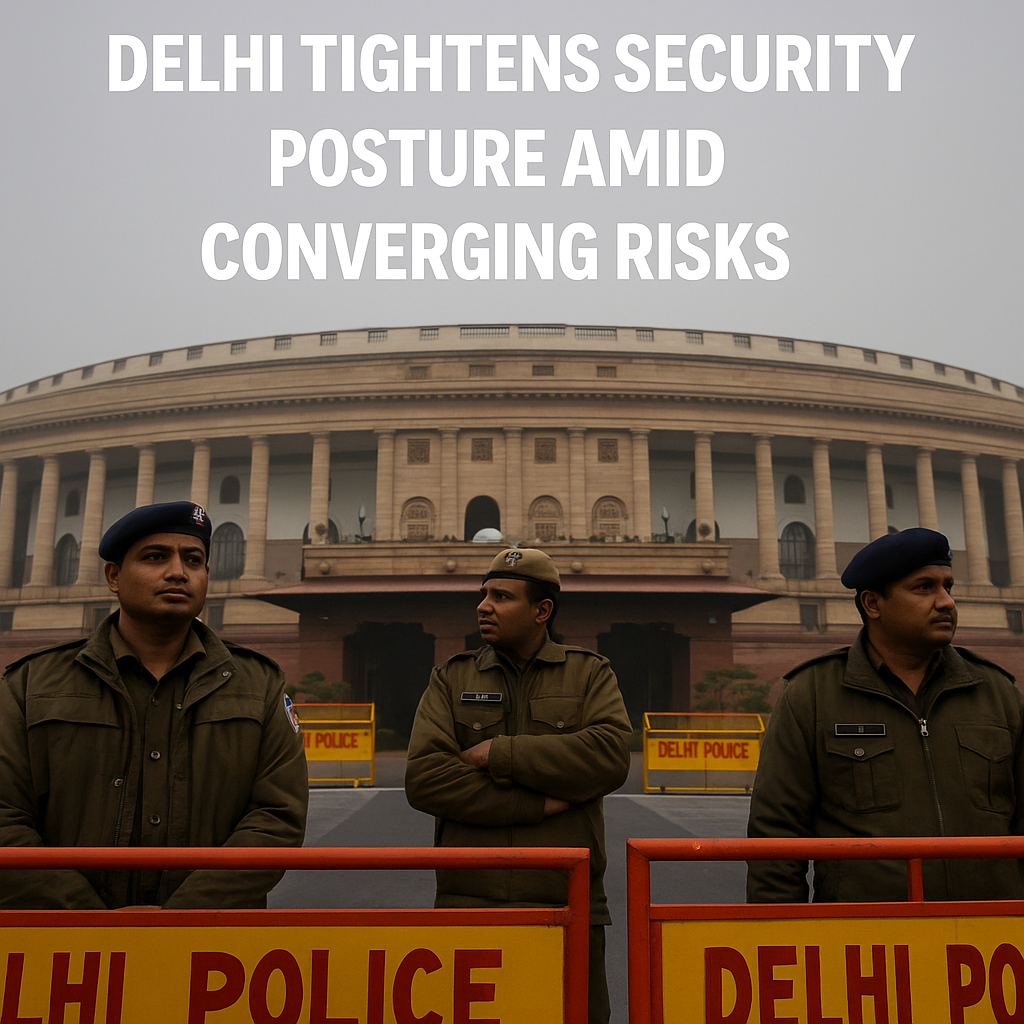

Delhi’s security agencies are working through one of their most demanding stretches in recent months. A major diplomatic visit, two historically sensitive anniversaries, and a public threat call have coincided within days, pulling multiple units into parallel operations. Officials describe the environment as “busy, layered, and changing by the hour,” with agencies required to maintain a wide security footprint across the capital.
The first and most visible reason for the heightened alert is the arrival of Russian President Vladimir Putin in Delhi.
Such visits don’t just involve a convoy and a venue schedule. They activate a city-wide network that includes multi-ring protection, route sanitisation, and anti-drone and anti-sabotage sweeps.
Teams from Delhi Police, SPG, NSG, and central intelligence agencies are coordinating movements down to minute-level precision. These deployments stretch across hotel zones, central Delhi corridors, and the routes marked out for the visit.
What residents may experience on the ground reflects this: slow-moving convoys, temporary barricades, and restricted access around key government blocks. These are routine parts of VVIP visits, but the scale increases significantly when the dignitary represents a major global power.
While the diplomatic presence alone would raise alert levels, Delhi enters this week with the approach of two dates that historically require heightened vigilance.
The anniversary of the Babri Masjid demolition, a day that routinely demands increased deployment around religious places and localities with a history of tension.
The anniversary of the 2001 Parliament attack, one of the most closely guarded dates in the national security calendar.
Both occasions require stepped-up monitoring simultaneously. This means more personnel at Parliament House, North and South Blocks, crowded markets, and major metro interchanges. It also means expanded surveillance reviews, where agencies re-evaluate intelligence inputs more frequently than usual.
A senior officer noted that anniversaries like these “don’t cause trouble by default, but they alter the vigilance map of the city.” In other words, these dates widen the zone where a higher degree of attentiveness becomes necessary.
Adding to this already demanding week is a recent video released by Sikhs for Justice (SFJ), a banned separatist organisation, threatening to “strike Parliament” ahead of December 13.
Authorities are not treating the threat at face value; rather, they’re treating it as a trigger for full precautionary protocols, since open calls—even if purely provocative—can influence fringe actors or inspire isolated attempts.
This has led to:
The threat does not indicate a confirmed plan, but its timing — right before a historically sensitive anniversary — elevates the city’s baseline alert.
What makes this week complex is not any single development, but the overlap.
This convergence means that almost every arm of the security matrix — from local police stations to specialised anti-terror units — is active at the same time.
Officials note that shift rotations are tighter, briefings are more frequent, and deployments leave little buffer for unexpected events. This is not unusual for Delhi, but the scale is larger than what an average week demands.
Delhiites may come across:
Authorities emphasise that these measures are precautionary and not an indication of immediate danger. They are part of a layered system meant to minimise risk and ensure smooth functioning across the capital.
Delhi’s security establishment is trained to manage complex weeks, but the convergence of protocol, memory, and menace — a visiting head of state, anniversaries tied to past violence, and a fresh threat warning — means the city must run on elevated alert for a few days.
For most residents, these measures translate into small adjustments: a few extra minutes at checkpoints or a slightly longer commute. For security agencies, it’s a week of wide coordination and constant readiness.
Delhi is managing three sensitive developments at the same time: a high-level diplomatic visit by Russian President Vladimir Putin, the approach of two significant anniversaries (December 6 and December 13), and a public threat issued by the banned group Sikhs for Justice. When these events overlap, security agencies increase their vigilance across the city.
December 6 marks the Babri Masjid demolition anniversary, a date that typically requires careful monitoring around religious and crowded areas. December 13 marks the Parliament attack anniversary, prompting strict security around government complexes and central Delhi. Both dates elevate baseline alert levels.
Security agencies treat all open threat calls as precautionary triggers, even if there is no direct evidence of an imminent attack. The SFJ video has led to increased surveillance, more anti-drone monitoring, and additional Quick Reaction Teams around key government zones.
Residents may notice slightly longer checks, more barricading, visible patrols, and occasional traffic diversions. These steps are preventive and designed to minimise risk while keeping the city functioning normally.
Yes. The enhanced security presence is meant to ensure safety. Public places remain open and operational, though some may have tighter entry checks or temporary movement restrictions.
The elevated security posture is expected to continue through the diplomatic visit and both anniversaries. Agencies will adjust their deployments based on evolving intelligence and on-ground assessments.
It’s advisable to allow a little extra travel time, especially around central Delhi or near VIP routes. Checking live traffic updates and metro advisories can help avoid delays.
Authorities have intensified anti-drone surveillance, expanded patrols, tightened access points, and increased coordination among Delhi Police, SPG, and central agencies. Only authorised personnel are permitted within the restricted zone during high-alert periods.
Part of the NCR Guide editorial team, covering news, real estate, food and lifestyle across Delhi NCR.
Join thousands of Delhi NCR residents who start their day with our morning brief — top stories, real estate updates, events and deals.