
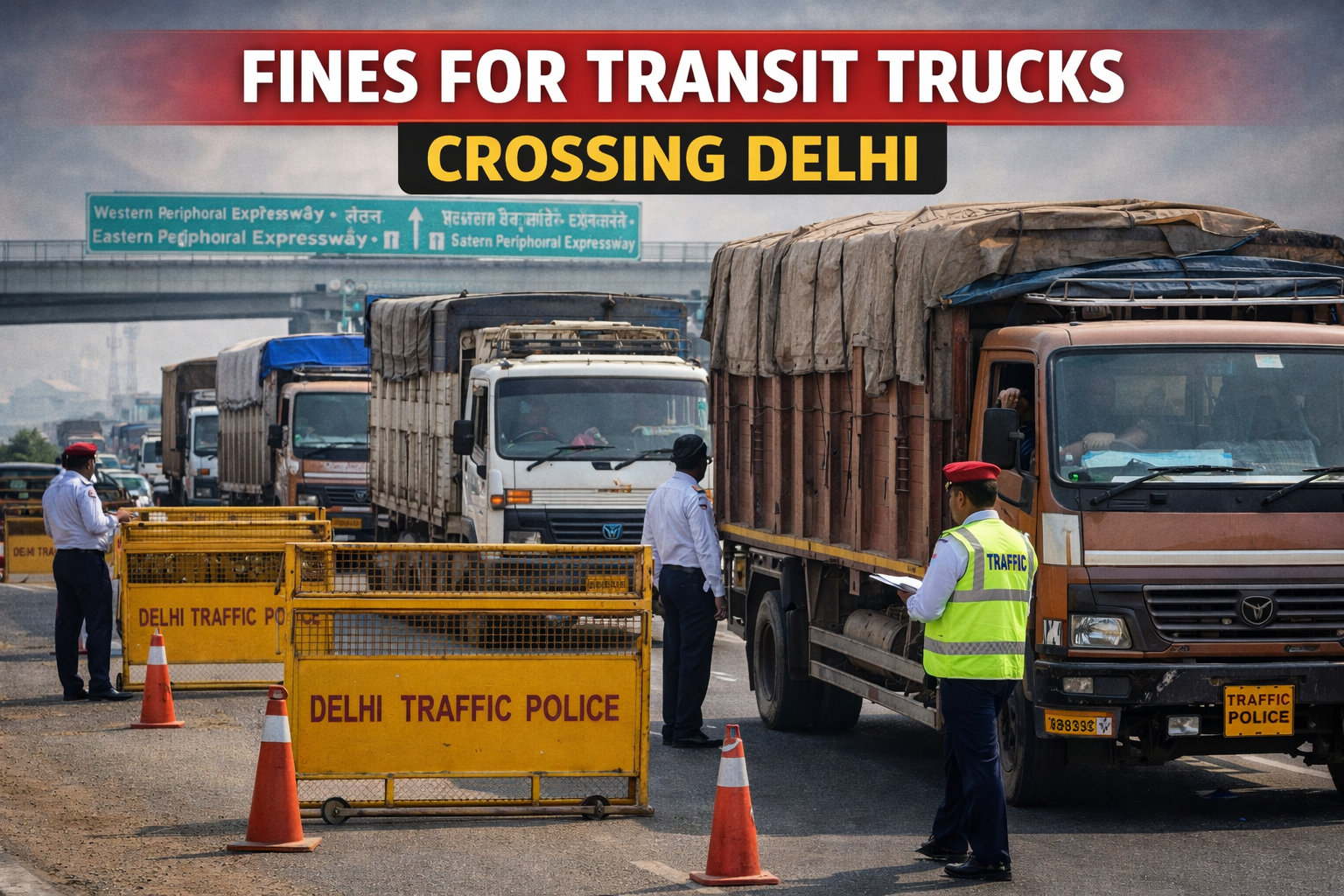

Delhi may soon see fewer interstate trucks passing through its roads after the Supreme Court of India cleared a proposal to raise penalties for vehicles that enter the capital only to pass through it.
For years, freight trucks travelling between northern states have used Delhi as a shortcut between highways. The court’s approval now allows authorities to increase fines on such vehicles, making it costlier for transport operators to use city roads instead of bypass expressways.
Officials believe stronger penalties could reduce both traffic congestion and pollution in the capital.
Delhi lies at the intersection of several national freight corridors. Trucks travelling between states such as Haryana, Punjab, Rajasthan and Uttar Pradesh often enter the city because it shortens their route.
But the impact of this transit traffic has been significant. Heavy diesel trucks contribute to particulate pollution, slow down traffic on major corridors and increase pressure on road infrastructure. Urban planners have long argued that interstate freight vehicles should avoid the capital entirely unless they have a delivery destination inside the city.
Authorities have been trying to enforce this principle for several years, though implementation has often been uneven.
The Supreme Court has allowed authorities to increase the financial penalty imposed on trucks entering Delhi only as a transit route. The aim is straightforward: make it expensive enough that transporters prefer to use bypass highways rather than city roads.
Implementation will involve multiple agencies including the Delhi Government, Delhi Traffic Police, and the Municipal Corporation of Delhi. These bodies monitor entry points to the capital and enforce movement rules for commercial vehicles.
The exact structure of the revised fines is expected to be finalised by the authorities after the court’s approval.
Delhi’s peripheral expressways were designed precisely to prevent interstate trucks from entering the capital.
Two major routes already serve this purpose:
• Eastern Peripheral Expressway
• Western Peripheral Expressway
These highways allow trucks to bypass Delhi entirely while travelling between northern states. When used properly, they keep heavy freight traffic outside dense urban areas.
Officials have repeatedly said that transit trucks should take these routes instead of passing through the city.
For people living and commuting in Delhi, fewer transit trucks could have noticeable effects.
Large freight vehicles occupy significant road space and move slower than most city traffic. Reducing their presence could improve traffic flow on arterial routes, especially during early morning and late-night hours when many trucks travel through the capital.
Air quality may also benefit, since diesel trucks are a major contributor to particulate emissions.
Whether these improvements materialise will depend on how consistently the new penalties are enforced.
Even with higher fines, enforcement will not be simple.
Authorities must determine whether a truck entering Delhi actually has a delivery destination inside the city. Some transporters may attempt to claim local delivery points to avoid penalties. Monitoring smaller border roads and internal routes also remains a challenge.
Traffic experts say technology-based monitoring, including number-plate tracking and route data, may be required to ensure that the rule works as intended.
The issue of transit freight traffic in Delhi has been debated for more than a decade.
2015–2016
The Supreme Court begins examining pollution sources in Delhi, including the role of heavy trucks.
2016
Authorities introduce environmental compensation charges for trucks entering the capital.
2018
The Eastern Peripheral Expressway and Western Peripheral Expressway become operational, offering dedicated routes to divert interstate freight traffic away from Delhi.
2020–2023
Truck entry restrictions are periodically tightened during high pollution periods.
2026
The Supreme Court allows higher fines to discourage trucks from using Delhi roads purely as a transit route.
Delhi sits at the centre of one of India’s busiest freight networks. Any change in how trucks move through the capital affects logistics patterns across the National Capital Region.
Stronger penalties could encourage transport companies to plan routes that stay outside Delhi’s urban core. That would increase reliance on peripheral expressways and reduce heavy vehicle pressure on city roads.
For residents, the decision represents another attempt to balance economic activity with the need for cleaner air and less congested streets.
The penalties are aimed at discouraging heavy trucks that pass through Delhi without having any delivery or pickup within the city. Such vehicles typically use the capital as a shortcut between national highways connecting northern states. However, this adds significant pressure on urban roads, contributes to air pollution, and slows down traffic movement. By increasing fines, authorities hope to encourage transporters to use bypass routes instead of entering Delhi unnecessarily.
The higher penalties primarily target transit trucks, meaning vehicles that enter Delhi only to cross the city and continue toward another destination outside the capital. Trucks that have a legitimate delivery or loading destination within Delhi are generally allowed to enter, provided they comply with the city’s existing entry rules and timings for commercial vehicles.
At Delhi’s border entry points, enforcement teams check documentation such as goods invoices, delivery challans, and route details. These documents indicate whether a truck has a legitimate destination within the city. If a vehicle is found entering Delhi without a valid local delivery point and is using the city only as a transit route, it may be subject to the increased penalty.
Trucks travelling between states are expected to use bypass highways designed to divert freight traffic away from the capital. Two key routes are the Eastern Peripheral Expressway and the Western Peripheral Expressway (Kundli–Manesar–Palwal Expressway). These highways form a ring around Delhi and allow vehicles to move between major national highways without entering the city.
If implemented effectively, the policy could reduce the number of large freight vehicles travelling through the capital. Since trucks occupy more road space and move slower than passenger vehicles, even a moderate reduction in their numbers could improve traffic flow on major corridors. However, the actual impact will depend on how strictly the rules are enforced at Delhi’s border checkpoints.
Delhi already has restrictions on when heavy trucks can enter the city. Many freight vehicles are allowed to enter during late-night hours to reduce congestion during the day. The new fines do not change these timing rules but instead focus on preventing trucks that have no business in Delhi from entering the city at all.
Heavy diesel trucks are among the major contributors to particulate emissions in urban areas. By discouraging unnecessary truck movement inside the city, authorities hope to reduce emissions from freight vehicles. While this step alone cannot solve Delhi’s air pollution problem, it could contribute to gradual improvement if combined with other measures.
Transport operators may need to adjust their routes and schedules to avoid entering Delhi when their cargo is not meant for the city. In many cases, using peripheral expressways may increase travel distance slightly but will reduce the risk of penalties and delays caused by enforcement checks within the capital.
Yes. Many large metropolitan areas across the world restrict heavy freight traffic within urban limits and encourage trucks to use ring roads or bypass expressways. Delhi’s approach follows a similar strategy, aiming to protect city roads from unnecessary freight movement while still allowing deliveries within the city.
The Supreme Court has cleared the proposal, but the exact implementation timeline will depend on administrative notifications from Delhi authorities. Once enforcement rules and penalty amounts are finalised, agencies such as the Delhi Traffic Police and municipal authorities will begin applying the revised fines at city entry points.
Part of the NCR Guide editorial team, covering news, real estate, food and lifestyle across Delhi NCR.
Join thousands of Delhi NCR residents who start their day with our morning brief — top stories, real estate updates, events and deals.