
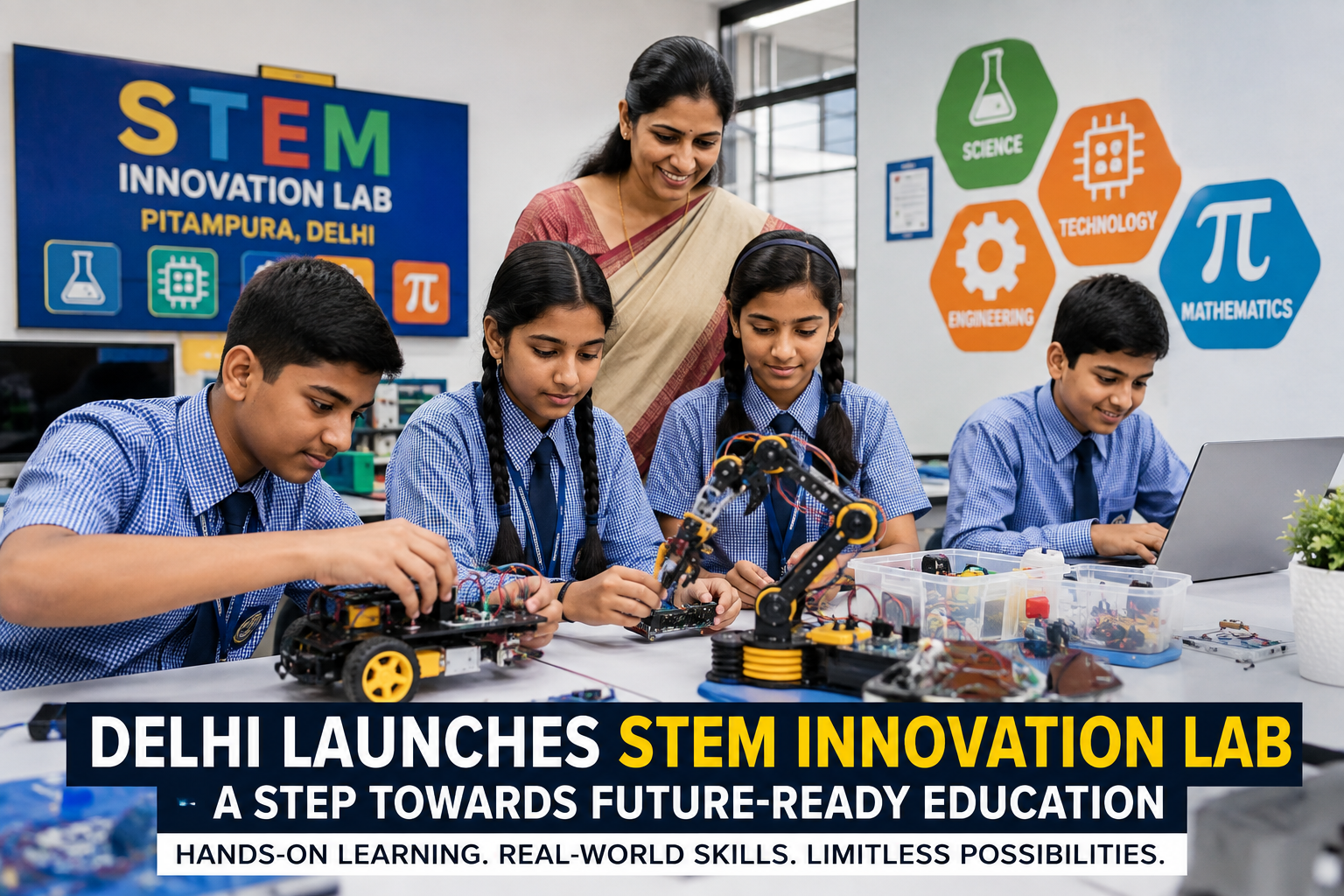

With AI, robotics and hands-on learning entering classrooms, Delhi’s latest STEM initiative could reshape how government school students learn, think and prepare for tomorrow’s careers.
For decades, classrooms across India have been built around a familiar model. Students listened, teachers explained, notes were copied, and examinations measured how well facts were remembered. While that approach helped generations of learners, the world outside the classroom has changed far more quickly than most education systems.
Artificial intelligence is transforming industries. Automation is redefining manufacturing. Data drives business decisions, while robotics, renewable energy and digital technologies are creating careers that barely existed a decade ago. The challenge for schools is no longer just teaching students what to learn, but helping them understand how to think, experiment and solve problems.
Against this backdrop, the inauguration of a STEM Innovation Lab at a government school in Pitampura is more than another education announcement. It reflects a broader shift in how Delhi wants its students to learn in the years ahead.
The new facility, launched by Delhi Chief Minister Rekha Gupta under the Saksham Programme, includes a STEM Innovation Lab, modern computer laboratories, smart classrooms and AI-enabled infrastructure. Developed in partnership with Honeywell and the Laadli Foundation through a Corporate Social Responsibility (CSR) initiative, the project aims to expose students to practical learning experiences that go beyond textbooks.
The announcement itself made headlines. But the bigger story is what happens after the ribbon-cutting ceremony.
A STEM Innovation Lab is designed to help students learn through exploration rather than memorisation.
Instead of limiting science and mathematics to textbooks and classroom lectures, these labs encourage children to build working models, test ideas, write basic code, assemble electronic circuits and understand how technology solves everyday problems.
The acronym STEM stands for Science, Technology, Engineering and Mathematics, but the concept is much broader than four academic subjects. It encourages students to combine knowledge from multiple disciplines while working on practical challenges.
For example, building a smart irrigation model may require mathematics to calculate water flow, science to understand plant needs, engineering to assemble the system and programming to automate it. Rather than studying each subject separately, students experience how they work together in the real world.
That approach develops not only technical knowledge but also critical thinking, creativity and collaboration—skills that employers increasingly value across every industry.
One of the most common misconceptions is that STEM labs are simply upgraded computer rooms.
They are not.
A well-equipped innovation lab introduces students to technologies that are already shaping the modern economy while encouraging them to experiment and learn from failure.
Depending on the school’s curriculum and available resources, students may explore:
| Learning Area | Practical Activities |
|---|---|
| Coding & Programming | Creating simple applications, games and automation projects |
| Robotics | Building and programming robots to complete basic tasks |
| Electronics | Working with sensors, circuits and microcontrollers |
| Artificial Intelligence | Understanding AI concepts through age-appropriate activities |
| Internet of Things (IoT) | Connecting devices and collecting real-world data |
| 3D Design & Prototyping | Designing models and solving engineering challenges |
| Renewable Energy | Creating small solar or wind-powered projects |
| Design Thinking | Identifying problems and developing innovative solutions |
The goal isn’t to produce engineers in middle school. It’s to nurture curiosity, helping students ask questions, test ideas and develop confidence in solving unfamiliar problems.
The Pitampura initiative reflects a larger transformation taking place across education systems worldwide.
Countries such as Singapore, Finland, South Korea, Germany and the United States have spent years introducing coding, robotics and innovation-based learning into schools. Their objective isn’t simply to improve examination results; it’s to prepare young people for a rapidly changing economy.
India is moving in the same direction.
The National Education Policy (NEP) 2020 places strong emphasis on experiential learning, multidisciplinary education and critical thinking, encouraging schools to move beyond rote memorisation. Programmes promoting coding, entrepreneurship, digital literacy and innovation are steadily becoming part of mainstream education.
For government schools, initiatives like the STEM Innovation Lab carry even greater significance. Access to advanced learning facilities has traditionally been concentrated in private institutions. By bringing similar opportunities into public schools, Delhi has the potential to reduce the digital divide and create more equitable learning environments.
The true success of these labs will not be measured by the number of computers installed, but by how effectively they inspire students to explore, innovate and develop skills that remain relevant long after they leave school.
A STEM Innovation Lab isn’t designed to replace the classroom. Instead, it complements classroom teaching by giving students an opportunity to apply what they have learned.
Consider a lesson on electricity. In a traditional classroom, students might study diagrams, definitions and formulas before answering questions in an examination. Inside a STEM lab, they could build a simple electrical circuit, connect sensors, troubleshoot faults and observe how the system behaves in real time.
The difference isn’t just in the equipment—it’s in the learning experience.
| Traditional Learning | STEM Learning |
|---|---|
| Focuses on theory | Combines theory with practical application |
| Individual assignments | Team-based projects and collaboration |
| Memorisation for exams | Solving real-world challenges |
| One correct answer | Multiple ways to approach a problem |
| Teacher-led instruction | Student-led exploration with teacher guidance |
This approach helps children become comfortable with experimentation. They learn that mistakes are part of the process, encouraging resilience and independent thinking rather than fear of failure.
One of the biggest strengths of STEM education is that it develops abilities that remain valuable regardless of the career a student eventually chooses.
While technical knowledge is important, employers increasingly look for people who can think critically, communicate clearly and adapt to new situations.
Students participating in STEM activities often strengthen skills such as:
These are skills that cannot easily be measured through traditional examinations, yet they are becoming increasingly valuable in higher education and the workplace.
The future job market will look very different from today’s.
Artificial intelligence, clean energy, automation, biotechnology, advanced manufacturing and space technology are creating opportunities that demand interdisciplinary knowledge rather than expertise in a single subject.
Students introduced to STEM learning at an early age are not expected to become AI engineers overnight. Instead, they gain confidence in working with technology, understanding how systems function and approaching unfamiliar challenges with curiosity rather than hesitation.
Some may eventually pursue careers in engineering, computer science or research. Others may become entrepreneurs, architects, healthcare professionals or designers. Even students entering non-technical fields benefit from stronger problem-solving and decision-making skills.
In that sense, STEM education prepares students for a future that is still evolving, making learning more flexible than career-specific.
Building a modern laboratory is only the beginning.
For STEM initiatives to deliver meaningful results, schools will need consistent investment beyond infrastructure. Equipment requires maintenance, software needs regular updates and teachers need ongoing training to confidently guide students through project-based learning.
Teacher development will be especially important. Introducing advanced technology into classrooms has limited impact unless educators are equally comfortable using it as a teaching tool.
Schools will also need enough flexibility within the curriculum to encourage experimentation without placing additional pressure on examination-focused learning.
Finally, access should remain a priority. A handful of model schools can demonstrate what is possible, but the larger objective should be to expand similar opportunities across government schools so that geography or family income does not determine access to quality learning experiences.
The STEM Innovation Lab inaugurated in Pitampura is unlikely to transform education overnight. Real change takes time, sustained investment and careful implementation.
Even so, the initiative represents an encouraging shift in priorities.
Instead of focusing solely on infrastructure or examination performance, it signals growing recognition that schools must also prepare students for a technology-driven world. Alongside smart classrooms and upgraded computer laboratories, innovation spaces can encourage curiosity, experimentation and collaborative learning from an early age.
If similar labs become part of more government schools across Delhi, they could help bridge long-standing gaps in access to modern education while nurturing a generation that is better equipped for higher education, entrepreneurship and emerging industries.
Technology alone cannot improve education, and no laboratory can replace an inspiring teacher. But when the right environment, trained educators and meaningful learning opportunities come together, classrooms begin to change in powerful ways.
The new STEM Innovation Lab in Pitampura is therefore more than a collection of computers, robotics kits or electronic equipment. It represents a different philosophy of education—one that encourages students to ask questions, test ideas, solve problems and create rather than simply memorise.
As India moves towards an increasingly digital and innovation-led economy, initiatives like these have the potential to shape not only how children learn today, but also how confidently they contribute to the world tomorrow.
A STEM Innovation Lab is a dedicated learning space where students explore Science, Technology, Engineering and Mathematics (STEM) through practical activities such as coding, robotics, electronics, engineering models and project-based learning. The focus is on applying concepts rather than simply memorising them.
The initiative aims to modernise classroom learning by giving students access to hands-on technology and innovation. It also supports Delhi’s broader efforts to prepare government school students with skills needed for an increasingly digital and technology-driven future.
A computer lab mainly teaches digital and computer skills. A STEM Innovation Lab combines coding, robotics, science, engineering and mathematics through practical projects, encouraging students to experiment, solve problems and work collaboratively.
Beyond technical knowledge, STEM education helps students build critical thinking, creativity, teamwork, communication, analytical reasoning and problem-solving skills. These abilities are valuable across almost every profession.
STEM education doesn’t prepare students for just one career. Instead, it builds a strong foundation for future opportunities in fields such as engineering, artificial intelligence, robotics, healthcare, research, data science and many other technology-driven industries.
The Delhi Government has been expanding digital learning initiatives, including smart classrooms and upgraded computer labs. While no city-wide rollout timeline has been officially announced, education experts expect similar innovation labs to gradually expand to more government schools.
Part of the NCR Guide editorial team, covering news, real estate, food and lifestyle across Delhi NCR.
Join thousands of Delhi NCR residents who start their day with our morning brief — top stories, real estate updates, events and deals.