
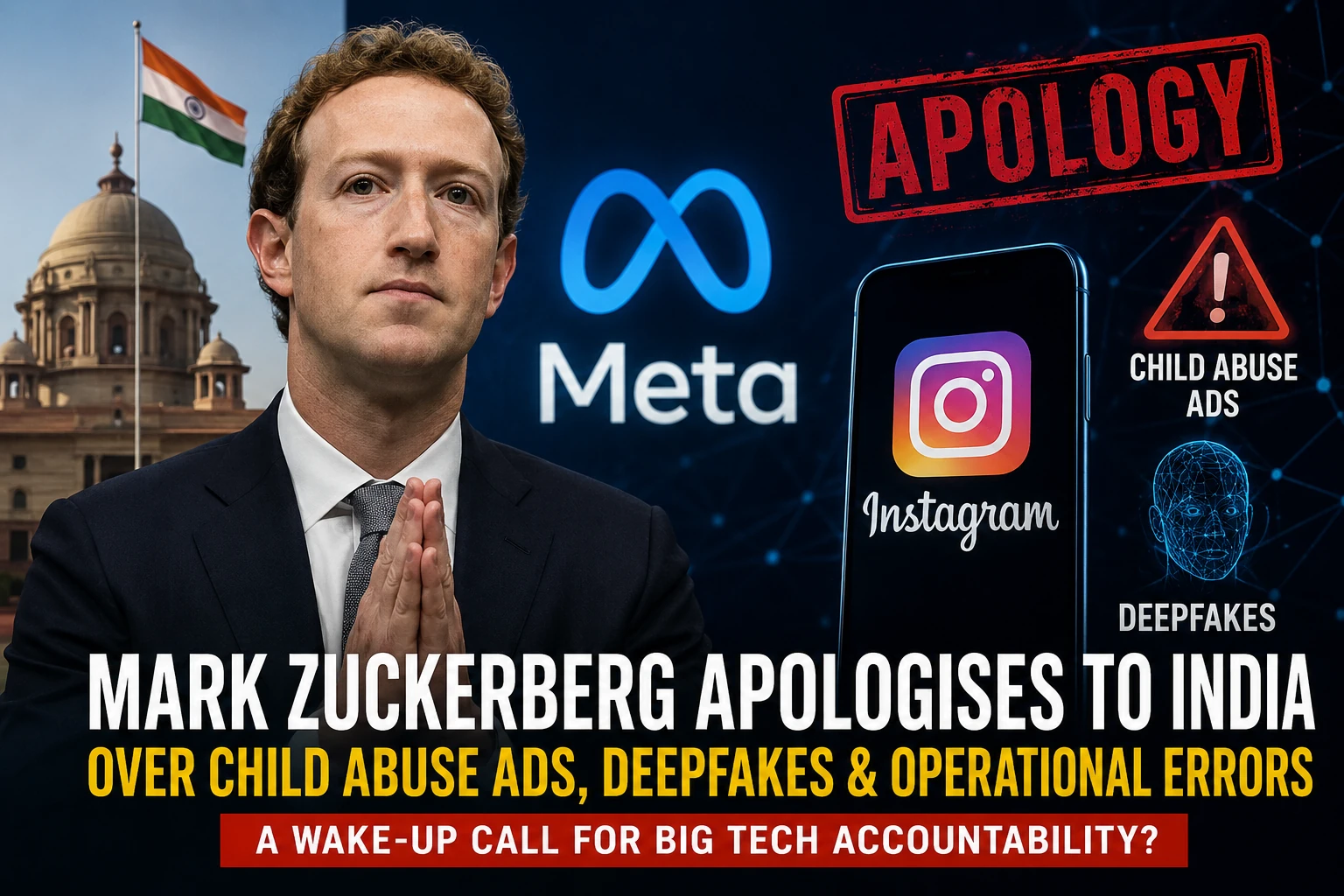

For years, governments across the world have questioned whether social media platforms are doing enough to prevent illegal content from reaching users. Those concerns took a significant turn this week after Meta CEO Mark Zuckerberg reportedly apologised to the Government of India over operational lapses involving child sexual abuse material (CSAM), deepfakes, and content moderation failures across Meta’s platforms.
While public apologies from global technology leaders are rare, what makes this one particularly noteworthy is the issue that triggered it. The controversy wasn’t centred on political speech, misinformation, or privacy concerns. Instead, it revolved around allegations that paid advertisements on Instagram were promoting access to child sexual abuse material, one of the gravest forms of online criminal activity.
The reports immediately drew the attention of India’s Ministry of Electronics and Information Technology (MeitY), which sought an explanation from Meta on how such advertisements were approved, why they appeared on one of the world’s largest social media platforms, and what safeguards had failed. The government also directed the company to remove the content without delay.
What followed was more than just a regulatory exchange. It became a broader conversation about the responsibilities of technology companies in the age of artificial intelligence, where billions of posts, images, videos, and advertisements are reviewed by automated systems every single day.
The chain of events began with a BBC investigation, which alleged that Instagram was displaying advertisements that directed users towards channels distributing child sexual abuse material. According to the report, some of these advertisements allegedly redirected users to messaging platforms where illegal content was being offered.
The findings quickly moved beyond a media investigation. They prompted immediate government scrutiny, raised serious questions about Meta’s advertising review process, and reignited concerns over whether AI-powered moderation systems are keeping pace with increasingly sophisticated attempts to bypass platform rules.
Unlike ordinary posts created by users, paid advertisements pass through multiple layers of automated and policy-based checks before they are approved. That distinction makes the allegations particularly serious. If illegal advertisements were able to appear on the platform, investigators naturally want to understand whether the safeguards failed, were circumvented, or simply weren’t sufficient.
For Meta, the controversy wasn’t just about removing objectionable content. It became a test of how transparent, accountable, and responsive one of the world’s largest technology companies could be when confronted with questions about user safety.
Social media companies have faced criticism before over fake news, election misinformation, hate speech, online scams, and privacy breaches. Most of those issues involved content created and shared by users.
This case is different.
Here, the spotlight is on Meta’s advertising ecosystem, a system designed to review campaigns before they reach millions of users. That has shifted the debate from “Why didn’t the platform remove harmful content quickly enough?” to a more fundamental question:
“How did such content receive approval in the first place?”
That distinction matters because advertising systems involve additional layers of screening, automated detection, advertiser verification, and policy enforcement. The expectation is that paid promotions should face even stricter scrutiny than ordinary posts.
The controversy has therefore become a conversation about platform accountability rather than content moderation alone.
Meta has consistently maintained that it has zero tolerance for child exploitation and has publicly stated that it invests heavily in technologies designed to detect and remove harmful content.
According to the company, its systems remove millions of pieces of violating content every year, using a combination of artificial intelligence, image-matching technology, behavioural analysis, and human review teams. Meta also says it works with child protection organisations and international safety databases to identify known abusive material before it spreads.
Yet this controversy highlights an uncomfortable reality.
Even sophisticated AI systems are not perfect.
Modern online abuse networks constantly evolve, changing keywords, images, links, and tactics to avoid automated detection. Generative AI has made the challenge even more complex, allowing harmful content to be disguised or manipulated in ways that are increasingly difficult for algorithms alone to recognise.
That is precisely why governments across the world, including India, are demanding greater transparency from technology companies about how their moderation systems work and where they continue to fall short.
At first glance, this may appear to be a story about government regulation and corporate accountability. In reality, its implications extend to every person who uses Facebook, Instagram, or Threads.
The outcome of this controversy could influence how advertisements are reviewed, how suspicious accounts are verified, how AI systems detect harmful content, and how quickly platforms respond to user reports. It may also shape future digital safety regulations, not just in India but in other countries watching closely.
For users, the issue isn’t simply whether Meta apologised. The more important question is whether this moment leads to meaningful improvements that make social media safer, more transparent, and more accountable.
Reports indicate that Zuckerberg’s apology covered three broad areas: the appearance of child sexual abuse material-related advertisements, the growing challenge of deepfakes, and operational shortcomings in Meta’s content moderation systems.
Although Meta has not admitted to deliberately allowing illegal advertisements on its platforms, the company acknowledged that its systems had not performed to the standards expected by regulators. That distinction is important.
An apology does not automatically amount to an admission of legal liability. Instead, it signals that Meta recognises the seriousness of the government’s concerns and intends to strengthen its safeguards.
For regulators, however, the focus extends beyond the apology itself. The larger question is whether the company can demonstrate measurable improvements in how harmful content is detected, reviewed, and removed before it reaches users.
While the allegations surrounding child exploitation understandably dominated public attention, deepfakes have quietly emerged as another major challenge for social media platforms.
Powered by artificial intelligence, deepfakes can create highly convincing videos, images, or audio clips that appear authentic but are entirely fabricated. What once required advanced technical skills can now be produced using freely available AI tools in a matter of minutes.
The consequences extend well beyond celebrity impersonations.
Today, deepfakes are increasingly linked to:
For platforms like Facebook and Instagram, identifying these sophisticated manipulations has become significantly more difficult. AI can create them, but AI must also detect them. That technological race is becoming more challenging every year.
India is not simply one of Meta’s largest markets. It is its biggest user base, with hundreds of millions of people relying on Facebook, Instagram, and WhatsApp every month.
That scale gives Indian regulators considerable influence.
Over the past few years, India has taken a noticeably firmer approach towards digital platforms, particularly on issues involving user safety, misinformation, and harmful online content. The government has repeatedly emphasised that technology companies operating in the country must comply with Indian laws regardless of where their headquarters are located.
The latest controversy reinforces that message.
Rather than treating harmful online content as an internal platform issue, authorities are increasingly viewing it as a matter of public safety and regulatory accountability. This reflects a broader global trend, with governments in the European Union, the United Kingdom, Australia, and several other jurisdictions introducing stricter obligations for major technology companies.
One of the biggest misconceptions surrounding content moderation is that every post is reviewed by a human being before it appears online.
That simply isn’t possible.
Platforms like Facebook and Instagram process billions of pieces of content every day, making human-only moderation unrealistic. Instead, they rely heavily on artificial intelligence to identify suspicious text, recognise harmful images, detect unusual account behaviour, and prioritise content for human review.
These systems have become remarkably sophisticated, but they are not infallible.
AI can sometimes remove perfectly legitimate content by mistake, while at other times failing to detect cleverly disguised harmful material. Criminal networks are constantly adapting their methods, changing keywords, altering images, using coded language, and shifting conversations to encrypted platforms to evade automated detection.
The result is a continuous technological contest where platforms improve their detection tools while bad actors develop new ways to avoid them.
That reality explains why regulators are no longer satisfied with simply hearing that AI is being used. They increasingly want to understand how effective those systems actually are, how quickly mistakes are corrected, and what additional safeguards exist when automation falls short.
Although this controversy centres on government oversight, ordinary users may also notice changes in the months ahead if Meta introduces stronger enforcement measures.
Possible improvements could include:
For most users, these changes may be subtle. However, collectively they represent a broader shift towards making social media platforms safer and more transparent.
Technology companies have long argued that moderation at internet scale is one of the most difficult challenges they face. Given the sheer volume of content uploaded every second, mistakes are inevitable.
That argument still carries weight.
But expectations have changed.
Today, governments and users expect platforms to do more than simply react after harmful content is discovered. They expect companies to prevent illegal content from appearing in the first place, respond quickly when failures occur, and explain transparently how those failures happened.
Mark Zuckerberg’s reported apology is significant because it reflects that changing landscape.
The debate is no longer about whether technology platforms have responsibilities. That question has largely been settled.
The real challenge now is whether artificial intelligence, human oversight, and platform governance can evolve quickly enough to keep pace with increasingly sophisticated forms of online abuse.
For Meta, this is more than a reputational issue. It is a test of trust.
And for billions of users worldwide, the outcome may help shape the future of digital safety for years to come.
Mark Zuckerberg reportedly apologised after the Indian government raised concerns over advertisements promoting child sexual abuse material (CSAM), the spread of deepfakes, and shortcomings in Meta’s content moderation systems. The apology acknowledged the seriousness of these issues and reaffirmed Meta’s commitment to strengthening platform safety.
The controversy gained momentum after a BBC investigation alleged that Instagram displayed advertisements promoting access to child sexual abuse material. The findings prompted the Ministry of Electronics and Information Technology (MeitY) to seek an explanation from Meta and order the immediate removal of the offending content.
CSAM stands for Child Sexual Abuse Material. It refers to images, videos, or other content depicting the sexual abuse or exploitation of children. The term is preferred over “child pornography” because it recognises that the material documents abuse rather than consensual activity. Possessing, distributing, or facilitating access to CSAM is a serious criminal offence in India and many other countries.
No. Meta has consistently maintained that it has zero tolerance for child exploitation and said it removes such content whenever it is detected. While the company apologised for operational shortcomings, it has not admitted to knowingly approving or promoting illegal advertisements.
Paid advertisements typically pass through additional review processes before they are published. They undergo automated screening, policy checks, and risk assessment. Because of these extra safeguards, allegations involving paid advertisements raise more serious questions about how the platform’s review systems functioned.
Deepfakes have become one of the fastest-growing forms of online abuse. They can be used to spread misinformation, commit financial fraud, impersonate individuals, or create non-consensual explicit content. Governments increasingly view deepfakes as a major digital safety challenge alongside child protection and online exploitation.
Meta uses a combination of artificial intelligence, image-matching technology, behavioural analysis, user reports, and human review teams to identify harmful content. While these systems remove millions of violating posts each year, no moderation system is perfect, particularly as bad actors constantly develop new methods to evade detection.
The Ministry of Electronics and Information Technology directed Meta to remove advertisements linked to child sexual abuse material immediately and sought a detailed explanation regarding how such advertisements appeared on Instagram. The government has also indicated that large digital platforms are expected to strengthen compliance with Indian laws and improve user safety.
Potentially, yes. Meta may introduce stricter advertising reviews, stronger identity verification for advertisers, improved AI detection systems, faster content removal processes, and additional safeguards against deepfakes and illegal content. Some changes may be rolled out globally, while others could be specific to regulatory requirements in India.
The controversy reflects a broader global shift towards greater accountability for technology companies. Governments across Europe, the United Kingdom, Australia, and other regions are also introducing stricter digital safety regulations. How Meta responds in India could influence its approach to content moderation and platform governance worldwide.
Not entirely. AI has significantly improved the speed of content moderation, but it can still make mistakes. Harmful content can be disguised using coded language, altered images, or new techniques that evade automated detection. Effective moderation usually combines AI tools with human reviewers and continuous system improvements.
Users should report the content immediately using the platform’s reporting tools, avoid sharing or engaging with it, block suspicious accounts where appropriate, and, in serious cases involving child exploitation or criminal activity, report the matter to the relevant law enforcement authorities or cybercrime portals.
Part of the NCR Guide editorial team, covering news, real estate, food and lifestyle across Delhi NCR.
Join thousands of Delhi NCR residents who start their day with our morning brief — top stories, real estate updates, events and deals.