
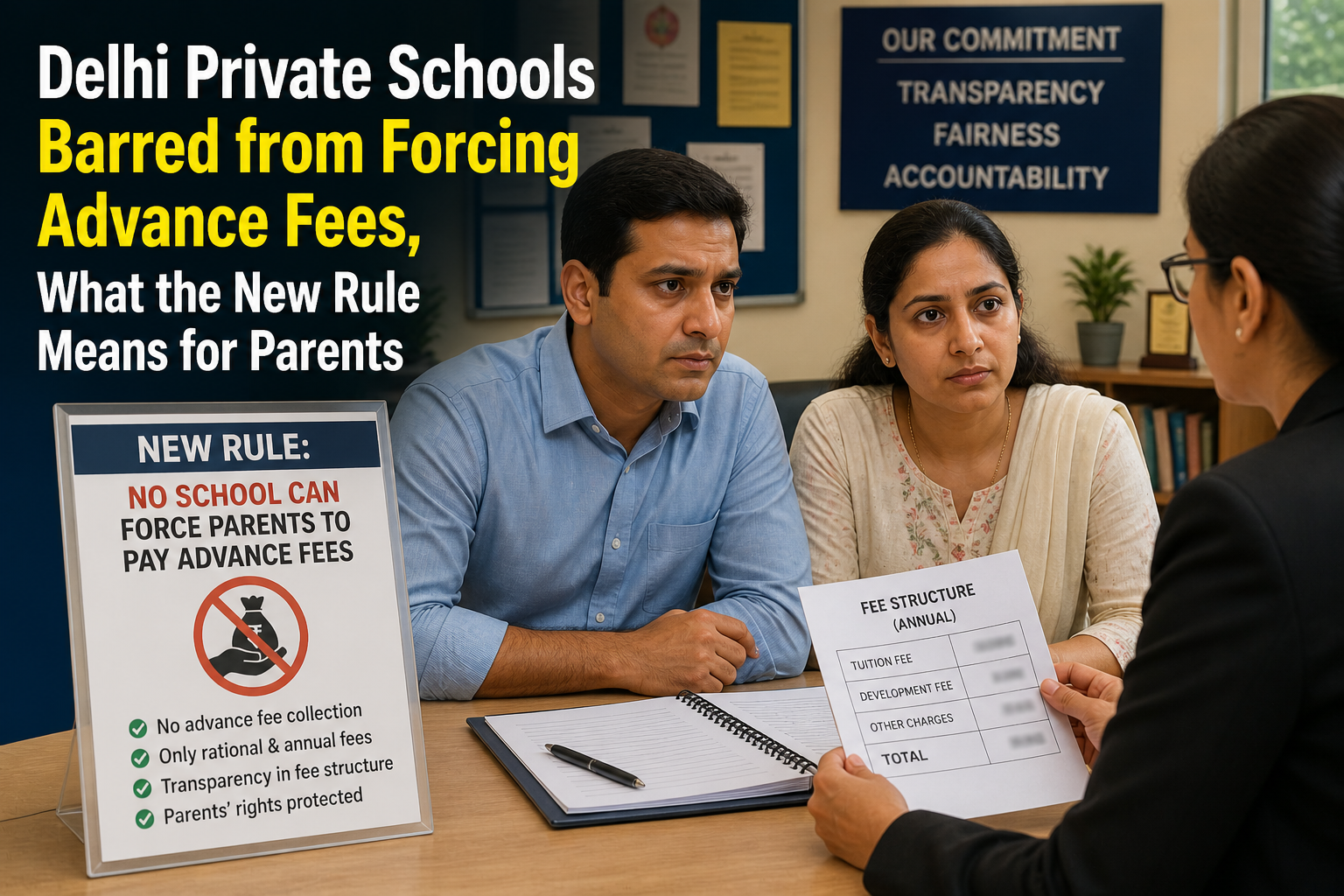

In a move that will bring relief to thousands of families, the Directorate of Education Delhi has made it clear that private schools cannot force parents to pay advance fees beyond the approved structure.
For many households already managing rising education costs, this shift comes at the right time. It addresses a long-standing concern where parents were often pushed into lump-sum or quarterly payments, creating financial pressure at the start of the academic year.
At its core, the directive puts a stop to a common practice. Schools can no longer compel parents to pay fees in advance outside the approved schedule.
Fee collection must follow a regulated cycle, typically monthly or as officially permitted, and not arbitrary demands set by individual schools.
More importantly, students cannot be penalised if parents refuse such advance payments. This means no denial of classes, no withholding of report cards, and no indirect pressure.
For many parents, school fees are one of the biggest recurring expenses. When payments are demanded upfront, the strain becomes immediate.
Over the past few years, there has been a steady rise in complaints about quarterly or annual fee demands, often without flexibility. Combined with inflation and rising living costs, this created a situation where education expenses felt unpredictable.
This rule brings a sense of stability and fairness, ensuring parents can plan expenses without sudden financial shocks.
The biggest change is control. Parents can now pay fees according to the approved schedule, without being pressured into advance payments.
If a school insists otherwise, parents have the right to refuse. Equally important, schools cannot take action against the child because of this refusal.
It is still advisable for parents to stay cautious. Keeping receipts, saving communication records, and documenting unusual demands can be useful if any issue arises later.
Schools can continue to charge fees, but only within the approved framework.
They are allowed to:
They are not allowed to:
This draws a clear line between legitimate fee collection and coercive practices.
The responsibility of enforcement lies with the Directorate of Education Delhi, which is expected to monitor compliance and act on complaints.
Parents can raise concerns through official channels if needed. However, the real impact will depend on how consistently violations are reported and addressed.
While the rule may appear simple, its impact could be significant. It moves the system toward greater transparency, predictable payments, and reduced conflict between schools and parents.
Schools may need to adjust financially, but for families, this creates breathing room and clarity.
This is a good time for parents to revisit their school’s fee communication.
They should ensure payments align with the officially approved schedule, and any demand outside this should be questioned.
Staying informed and proactive will help parents fully benefit from this change.
Schools can request fees only as per the approved payment schedule. They cannot force parents to pay advance or lump-sum fees outside these norms.
Parents can refuse such demands and keep records of communication. If pressure continues, the matter can be reported to the Directorate of Education.
No. Schools are not allowed to penalise students for non-payment of unapproved advance fees in any form.
Yes, it applies to private schools operating under Delhi’s regulatory framework.
Complaints can be filed through the Directorate of Education’s official grievance channels, including online systems.
Schools found violating guidelines may face regulatory action under education rules, depending on the severity of the violation.
Part of the NCR Guide editorial team, covering news, real estate, food and lifestyle across Delhi NCR.
Join thousands of Delhi NCR residents who start their day with our morning brief — top stories, real estate updates, events and deals.