Ludo rules: the basics, and the house rules families argue about
Every family plays Ludo slightly differently, and the arguments usually start with “but we always played that…”. Here are the Ludo rules most Indian homes agree on, followed by the house rules that cause the arguments, so you can settle them before the dice come out. Our free Ludo game uses these rules, with the house rules as options.
The board and the tokens
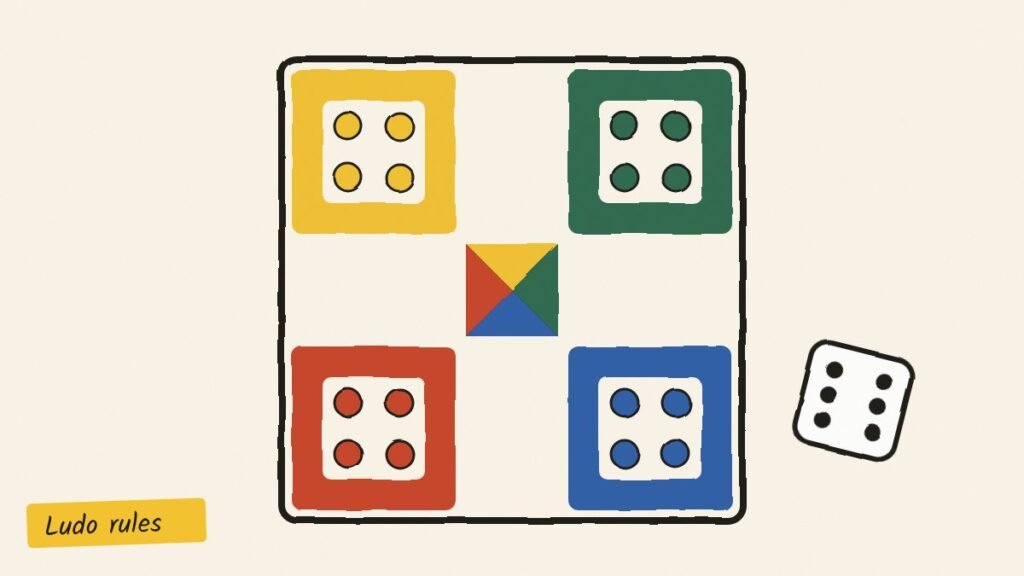
- 2 to 4 players. Each has 4 tokens in their own coloured yard.
- Tokens go clockwise round the 52-square track, then up their own 5-square home column to the centre.
- One die. Players take turns clockwise, and the highest first roll usually goes first.
Bringing a token out
You need a 6 to move a token out of your yard onto your start square. Until you roll a 6, you can’t move at all, which is where most of the early groans come from. Every token needs its own 6 to come out, so a game with all four tokens in the yard can feel slow at the start.
Sixes and extra rolls
- Rolling a 6 earns another roll.
- So does capturing a token, and getting one of your tokens home.
- Three 6s in a row and your turn ends; the third 6 isn’t played.
Capturing
Land exactly on another player’s token and it goes back to their yard, where it needs a fresh 6 to come out. The exception is the 8 safe squares: the coloured start squares and the squares marked with a star. Nobody can be captured there, and tokens of different colours can share them.
Getting home
To reach the centre you need the exact number. If you need a 3 and roll a 5, that token can’t move, though you can still move another token with the 5. If no token can use the roll, the turn passes. The first player to get all 4 tokens home wins, and the others can play on for second and third place.
House rules families add
- Capture to open home: your tokens can’t go up your home column until you’ve captured someone. It makes the game longer and much more competitive.
- Quick Ludo: 2 tokens each instead of 4, for a shorter game.
- Blitz: a game of about 5 minutes. Everyone gets the same number of turns, and when they run out, the most tokens home wins.
- Blocks: in some homes, two tokens of the same colour on one square make a block that nobody can capture or pass. Our game doesn’t use blocks, so agree on it before you play on a board.
- A 1 to come out: a few families let a 1 bring a token out as well as a 6. It speeds up the start, which helps with small children.
Ludo tips that actually help
Ludo is mostly dice, but the choices add up over a game. A few habits that win more often:
- Count behind you. A token is in danger when an opponent sits 1 to 6 squares behind it. Moving it out of that range, or onto a star, often matters more than moving the leader.
- Use your 6s to bring tokens out early. A token in the yard can’t be captured, but it can’t help you either, and you’ll want choices later in the game.
- Don’t race one token alone. Spread your moves so a single bad roll doesn’t leave you with nothing to play.
- Capture when it counts. Sending back a token that is nearly home costs its owner far more than capturing one that has just come out.
- Park on safe squares near the end. The last quarter of the track is where captures hurt most.
Ludo with young children
Ludo is a good first counting game: children count the pips, then count the squares, and quickly learn that 5 and 1 make 6. Play with 2 tokens each, let a 1 or a 6 bring a token out, and drop the three-sixes rule for the first few games. Our game’s Easy computer player gives a fair game without winning every time.
Where Ludo comes from
Ludo is a simpler version of Pachisi, the cross-and-circle game played in India for centuries, famously on a life-size courtyard board at Fatehpur Sikri. A version with a die instead of cowrie shells was patented in England in 1896 under the name Ludo, Latin for “I play”, and came back to Indian homes in that form.
Questions people ask about Ludo
Do you need a 6 to start in Ludo?
Yes, in the standard rules each token needs a 6 to leave the yard. Some families also allow a 1, which makes the start quicker.
Do you get another turn after capturing a token?
Yes. Capturing a token earns an extra roll, just like rolling a 6 or getting a token home.
What happens if you roll three 6s in a row?
Your turn ends straight away and the third 6 is not played. It stops one lucky player running away with the game.
Can you capture a token on a star square?
No. The 8 safe squares, the stars and the coloured start squares, protect every token on them.
Do you need an exact roll to get home in Ludo?
Yes. A token reaches the centre only with the exact number; if the roll is too big, move another token or pass.
Is Ludo a game of luck or skill?
Both. The dice decide what you can do, but choosing which token to move, when to capture and when to hide on a safe square makes a real difference over a full game.
Play Ludo online, free
Our Ludo game plays in the browser with nothing to download. Play 2 to 4 players on one phone, against the computer, or in an online room where everyone plays on their own phone. Try a best-of-three Ludo Cup with cousins in another city. More classics are in Indian Classics, including carrom, with its rules here.